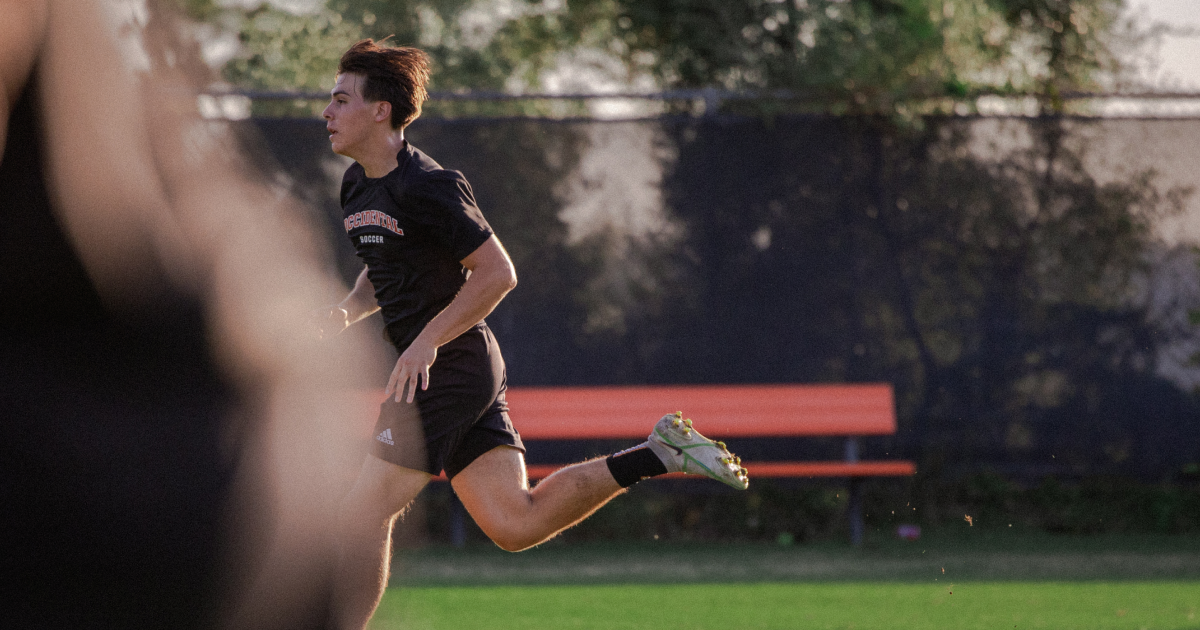
Kent Ortiz and his Occidental College teammates were on Zuma Beach with one ball, keeping it in the air between them. Most people who carry a ball onto a beach juggle for about ten minutes, then put it down and go in the water. Half an hour in, Ortiz and his teammates were still going. An hour in, they were still going, taking turns, setting each other harder problems.
Marvin Heilbronn, the photographer shooting Veo’s Young Player Portfolio series, was about a hundred meters down the sand with a ball of his own and nobody to pass with. He usually begs his friends to keep a session alive, so he recognized what he was seeing and walked over.
"There are people who bring a ball to the beach and juggle for five, ten minutes," Heilbronn says. "You guys were out there for an hour minimum, proper juggling, trying to get the most out of it, challenging yourselves."
He wanted to know what keeps a group of players on the sand for an hour when the sea is right there.
The answer goes back a long way, to a father who put down his own sport.
Playing Up
Ortiz was born in Idaho and raised in California. He started playing when he was just four years old. Born in 2007, Ortiz spent his early years on a 2005 birth-year team, a full two years young for the group.
"That definitely helped me a lot, confidence-wise," he says, "knowing I could hang with the older guys, that I wasn't getting pushed around."
His dad also took him out to train on the days there was no team session. An hour, most days, for years. He never hid the reason. Playing above his age group was how he would get good enough to stay there, and the extra hour was how he would keep up. He carried the habit into college.
What His Parents Put Down
Both of Ortiz's parents are Mexican immigrants, and both of them gave up something to work. His father loved basketball and had nobody around him to support it, so he stopped playing and took a job. His mother left home very young to go to work, and missed much of her own childhood doing it. She got the rest back later. She came to the United States, earned a bachelor's degree and then a master's, and did both while she was still learning English.
"To me that's a big inspiration," Ortiz says.
His parents told him he did not need to find a job, and he decided what to do with that.
"School is my way of work," he says. "I'm not working, so I'm going to make sure I have A's and show my parents I'm grateful for everything they've done for me, taking me to practice and all that. That was my way of paying back."
His father spent years telling him he would make a good lawyer. Ortiz took college-level law classes in high school to find out, enjoyed them, and found that the pull was somewhere else. When he came back and said medicine, his dad's answer was short.
"That's still really good."
The Captaincy That Took One Weekend
The move that changed his football came in his junior year of high school, when he left his local club for an MLS Next side an hour from home. New team, new commute, nobody in the building who knew him.
"I just let the football talk for me," he says.
By the first tournament, he was starting and playing the full ninety. That same weekend, the team made him captain. He kept the armband and the ninety minutes through his senior year, and finished it in the MLS Next Best of/ Uncommitted Match with college coaches along the sideline and his family in the stands.
Then he arrived at Occidental, where the accepted wisdom is that freshmen wait their turn.
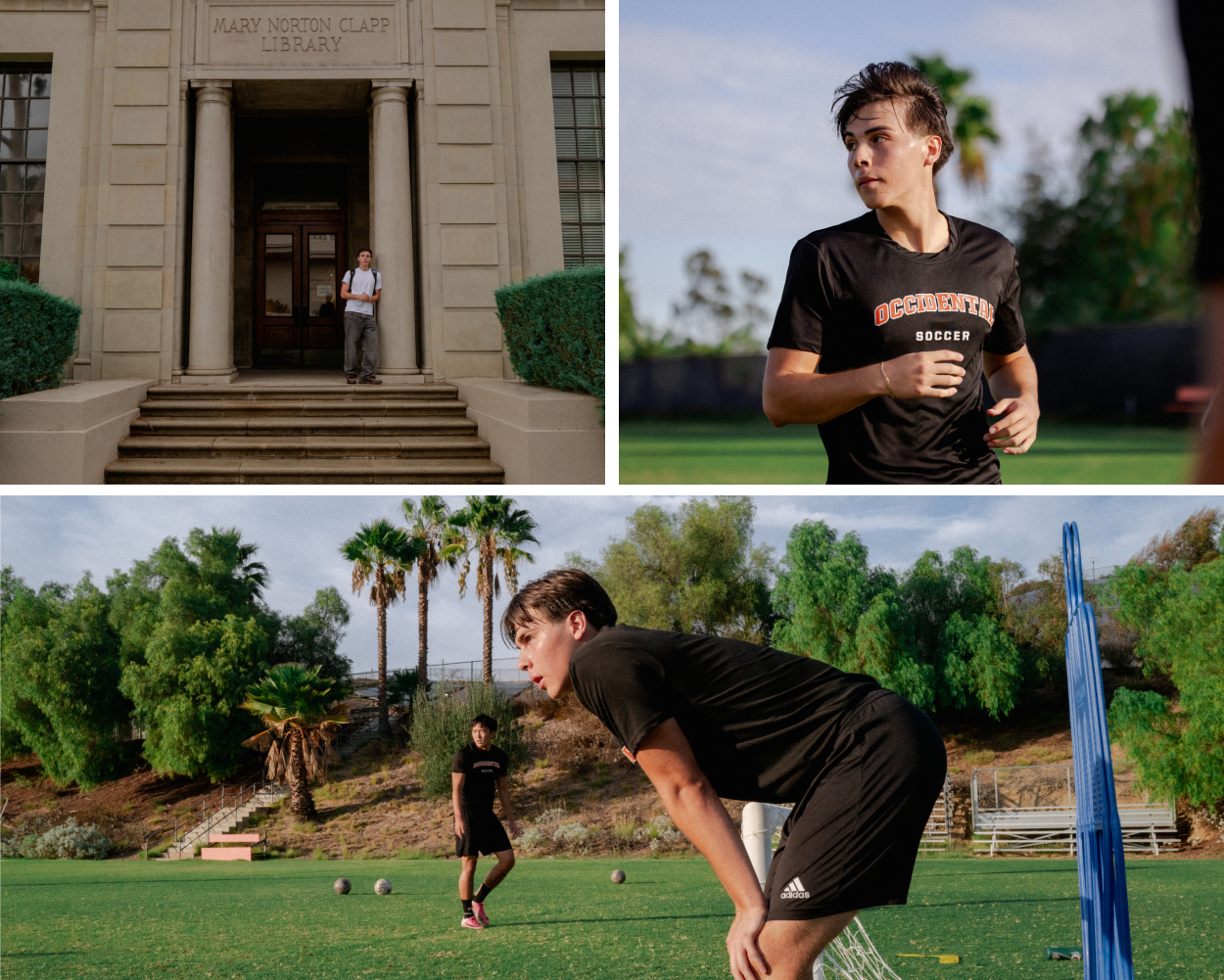
"I came in with the mindset that if I play five minutes, I'm going to do my best in those five minutes," he says, "and at practice I'm going to prove why I should be the first or second option."
He started 17 of 20 matches that year, logged more than a thousand minutes, and scored once.
Taking the 6 Back
Ortiz came to Occidental as a 6, the deepest midfielder on the field, the one who sits in front of the defense and starts the play again every time it breaks down. The problem was that the 6 was already taken by one of the best players he had shared a pitch with. So his coach moved him to the 8, the box-to-box job a line further forward, and told him to learn it. He learned it, started there, and when the older player graduated, he went back and took the 6 for himself.
"I plan to keep it for me," he says.
A preseason injury in his sophomore year cost him the first two scrimmages and his place in the side. He came back off the bench in the first proper preseason match with one instruction for himself.
"As soon as I came on, I told myself I'm going to prove why I was a starter as a freshman," he says. "So once I came on, I didn't come off."
By the second game, the starting spot was his again.
One of his coaches compared him to Federico Valverde, the Real Madrid midfielder, which he accepted with the required diplomacy of a Barcelona supporter. "I was like, okay, that's a nice comparison," he says. "I'm more of a Barça fan myself, but you've got to give your respect."
Ask him what he actually does on the pitch and the answer is unglamorous and precise. He keeps it simple. He makes the game look fluid.
"I know I'm not the fastest, so when it comes to 11s, I know I'm not going to get the ball on the wing and take a guy down, run 40 yards and whip it in," he explains. "But I know that in the midfield, in that 6 space, if I get the ball I'm going to be able to turn, switch it to the other side, or find my 9 running down, or find my 8 making a run."
On a 7v7 pitch he does a different job. The distances are short enough that top speed stops mattering, and the half-yard he gets from close control is enough to take a defender on himself.
"That's where I think I can go and score those goals, because of the movement I have on the ball," he says. "I can get by a defender pretty quick and get a good shot on frame."
Under pressure, he stays quiet, and he credits a line a coach passed on to him.
"You don't rise to the occasion, you fall to the level of your preparation."
Nobody can say for certain who said it first. The line moves through American locker rooms in a dozen versions, hung on an ancient Greek poet in some of them and an anonymous Navy SEAL in others. Ortiz got it from a coach, and he can point to where his own preparation came from. A father, a ball, and an hour a day for years, including all the days when nobody was checking.
West Coast, East Coast
Ortiz has a theory about the game in America that he has clearly tested against a lot of opponents.
"East Coast is a lot of athletic play; how can I use my athleticism to run down the line and body through a couple of guys," he says. "But on the West Coast I've seen a lot of players with such raw technical ability, or the confidence to get the ball and think, I'm going to take this guy on and beat him 1v1."
He has played both, and he can describe the difference physically. Against East Coast teams, there are elbows, and players climbing five feet in the air to win a header. Against West Coast teams, the ball moves well enough that he wants to stop and watch it.
"East Coast is more of a physical battle," he says, "while West Coast ballers, it's a technical battle, a lot of thinking, like, what am I going to do now if I hit him with this skill, or how am I going to stop him now."
A technical game gets built in the hours nobody organizes. On a beach on a weekend afternoon, with a handful of players, one ball, and nothing at stake, which is exactly where Heilbronn found him.
In the Lab Since Nine
The interview for this piece happened while Ortiz was sitting in the Navarro lab at Occidental, where he had been since nine that morning. He is majoring in biology on the pre-med track, and this fall he moved from shadowing other people's work to running his own reactions for the first time.
The research is in organic chemistry. The Navarro Lab leverages its expertise in synthetic organic chemistry to expand the breadth of transition-metal-catalyzed coupling reactions as it says on their website.

He made room for all of it years in advance. Those college classes he took in high school, the ones that started as an experiment in law, left him with enough credits that he carries only three courses during the season. The free slot goes to training and lab hours.
He gives player talks at his coach's ID camps, and the kids always ask the same thing about being a college athlete. He tells them the answer is boring.
"It's honestly all about time management. You can be great at both, but you just have to know how to manage your time," he says. "You could be a great soccer player, but ignore all of school, and then you become ineligible because you're no longer a good student. Or you could be amazing in the classroom, but if that time comes out of practice and your individual touches, it'll show on the field. You'll lag behind."
He is a sophomore, dispensing this advice to children who aren't much younger than him.
The Hour
Ten assignments due that night, a lab day that had started at nine, and an hour with the ball anyway.
"I could have ten assignments due that night, and it's something my dad instilled in me: that you have to train every day, even if it's just an hour," he says. "Sometimes I didn't like it; I'd think I don't have to today. But I started to realize that one hour was my one hour of peace, where I didn't have to worry about my assignments, any issues at school, anything consuming my mind."
The hour his father imposed became the hour he defends.
"As soon as I started keeping the ball around, it's just peace in my mind. I don't have to stress about any of that," he says. "Genuinely, my happy place. That's the simplest way I can put it."