College Soccer Recruiting Video: How SRUSA Assesses Players
Frederik Hvillum
Chris Cousins of Sports Recruiting USA on how college soccer recruiting video has transformed player assessment, scouting events, and getting players into US colleges.
Chris Cousins is the founder of Sports Recruiting USA, the world's leading US college soccer recruiting agency. SRUSA operates across every continent, placing players from all levels, from grassroots to professional clubs and national teams, into US college programmes at all divisions. He has been using Veo for six or seven years and has a precise view of what college soccer recruiting video has changed for his business and for the players he works with.
Before accessible video, assessing a player required one of two things: sending a scout to watch them play, or running an event and asking the player to travel. Both cost time and money. Neither was scalable.
That calculation has changed completely. Chris Cousins runs Sports Recruiting USA from wherever he happens to be, and he can assess players across the world in hours rather than weeks. He is not the only one working that way: SRUSA's agents are based in different parts of the world, so a player's footage can be passed to a colleague on another continent for a second opinion. The shift did not happen because SRUSA changed how it worked. It happened because video became available everywhere.
How college soccer recruiting video transformed player assessment
"Before, when we were assessing players, we'd have to spend a lot of time going to watch them, or we'd have a lot more events so people would have to come to us. Video wasn't really as available for anybody outside of a professional club. So it was really difficult to assess players," Cousins says.
The change is visible in the numbers. Where SRUSA once operated predominantly through in-person scouting and events, roughly 80 percent of the assessment process is now done remotely. Players apply through the website, include a full game and highlight video, and the agency can evaluate them the same day from anywhere in the world.
"I'd say nine times out of ten, if you ask a player for a full game, it comes to us and it's a Veo product. From an assessing point of view, it's made our lives so much easier just having the product out there," Cousins says.
The efficiency gain runs in multiple directions. A player who used to wait three weeks for the next available event to be seen now gets an answer in 24 to 48 hours. SRUSA staff can share footage internally and ask colleagues in different parts of the world for a second opinion. And Cousins himself, whether he is in an office, a hotel room in Portugal, or anywhere else, can work through applications in a few hours rather than booking flights.
The relationship between video quality and recruiting outcomes is direct. Read how to create a college soccer recruiting video that coaches actually watch.
Why watching video is better than watching in person
Cousins makes a counterintuitive observation about the difference between watching a player live and watching them on footage. For recruitment purposes, he prefers the footage.
"I've put my VR Meta Quest headset on and watch it in multiview mode, and I just stay tracking the player and watch him like that. This has allowed us to watch the player all the time. Off-the-ball stuff has been really good. I find watching it on a Veo system a lot better than watching in real life, because of distractions when I'm there. You're talking to people. But when I'm watching it by myself, I can just concentrate on the player," Cousins says.
The particular value he identifies is off-ball movement. A professionally filmed broadcast follows the action. A camera placed to capture the full pitch allows a scout to track a player through every phase of play, including the phases where they do not touch the ball. For recruitment purposes, that is often where the most important information is.
Using analytics to rank players at scouting events
SRUSA runs two kinds of events. Showcases for existing clients who need footage to send to college coaches. And assessment events for players who want to join SRUSA's service and need to be evaluated in person for the first time.
At a recent assessment event, SRUSA used Veo Analytics 2 for the first time to generate objective data on every player across the full game. The data was combined with physical testing metrics collected earlier in the day and fed into AI to produce a ranked list of players.
"We found out how to do all that for both teams. We had everyone's sort of stats, the full stats for the full event. And then we put that into AI with our stuff we did before, which is not game-related, and then we kind of ranked the players for the event using both sorts of metrics," Cousins says.
The ranking produced a result that challenged one of the scouts' initial impressions. A player who had scored three goals in the game was ranked fourth. Another scout argued he should be first. The conversation that followed is a precise illustration of what objective data does to subjective disagreement.
"I said: well, look at his stats. 15 chances, but his passes were all over the place. He didn't really run much. His heat map was kind of, like, he might as well have been a referee, just one spot. And you're like, all right, fair enough. So the argument got quickly resolved," Cousins says.
The practical consequence went beyond the internal debate. Every player at the event received a personalised report with their full statistics.
"No complaints at all, because how can you complain when there's literal stats and tangible information in front of you," Cousins says.
The combination of full-game footage and statistical data is increasingly what college coaches expect when evaluating players. Read about the goalkeeper who got into Harvard on match footage.
Benchmarking: what the availability of footage has made possible
Beyond the direct assessment of individual players, Cousins points to a broader shift that the availability of soccer footage has created: the ability to benchmark. When video was scarce, evaluating whether a player was Division I, Division II, or Division III quality required extensive in-person scouting and years of calibrated judgment. Now there is footage at every level to compare against.
"It's made video more available at all levels by everyone around the world. So there's more you can benchmark against other people, because you can watch other footage. There's just more video available, which makes it easier to assess but also benchmark," Cousins says.
The direction he sees this heading is toward automated grading: AI that can evaluate footage across multiple games, understand the level of opposition and teammates, and produce an objective assessment of where a player sits relative to the college system. That would remove much of the remaining manual work from the initial assessment process.

"After a few games, you could be identified as: this player is of a level to be in a Premier League Under-18 Academy. They play and act and move the same as somebody at that level. So it understands the level of opposition, the level of teammates, and it can give you a grading. That's coming," Cousins says.
The WhatsApp workflow and why nearly every video is Veo
Once a player is accepted onto SRUSA's service, a WhatsApp group is created for the player, their family, and the assigned consultant. Every time there is new footage, whether a full game or a key clip, it gets shared in the group. When a college coach asks about a player, SRUSA can respond immediately with the latest footage.
"Every time they've got any new clips that they've got from their club or a full game where they've done well, they just drop it into the WhatsApp group. So then when we're speaking to coaches, we'll be like, oh, actually, yeah, the latest game was this weekend, and here you go. And I'm not just saying this: it generally nearly always is Veo," Cousins says.
That consistency matters operationally. When footage arrives in a consistent format, it can be shared immediately via link without downloading, uploading to YouTube, or any additional processing. The link goes to the coach. The coach watches it. The player gets evaluated.
The whole friction that existed in the old workflow, paying someone to film, paying someone to clip, paying an analysis company to produce stats, has been removed or automated. What remains is the judgment: understanding what the footage shows, what level a player is playing at, and what college programme is the right fit.
Building a video package that works for college coaches requires more than just sending a link. See how to record and present soccer recruiting videos effectively.
How Veo supports sports recruitment and player assessment
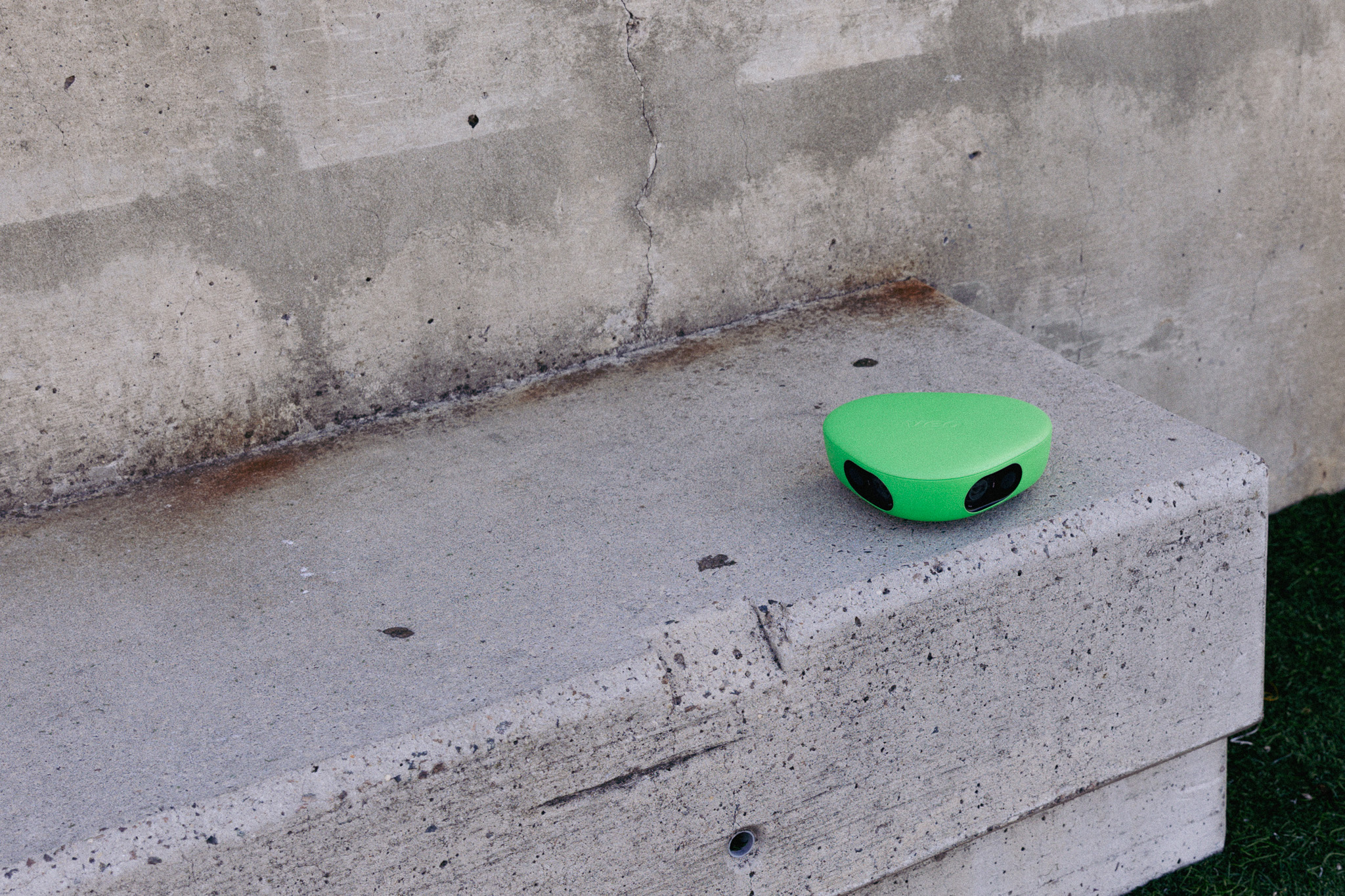
Veo is an AI-powered camera system that records matches and training sessions automatically, without a dedicated camera operator. The camera is placed on a tripod at the halfway line and uses computer vision to track the ball and follow play across the full pitch.
After a match, footage uploads automatically to the Veo platform, where it can be shared via direct link with recruiters, college coaches, and scouts worldwide. Veo Analytics 2 provides match data including pass completion, distance covered, heat maps, and shot information. The footage is available in a consistent format that requires no additional processing before sharing.

FAQs
College coaches typically want a combination of a full game and a curated highlight reel. The full game allows them to evaluate a player across the full 90 minutes, including off-ball movement, defensive contributions, and performance in phases where the player is not directly involved in the action. Highlights serve as an efficient introduction, but most coaches will want to see full footage before making a serious evaluation.
Video allows players to be evaluated remotely and quickly, without waiting weeks for a scouting visit or an available event. A player who submits quality full-game footage to a recruiting agency can receive an assessment within 24 to 48 hours. Good footage also allows college coaches to evaluate players they could never physically travel to watch, significantly expanding the pool of schools a player can realistically reach.
Scouts and recruiting agencies look at both on-ball and off-ball performance. On-ball assessment covers technical quality, decision making, and efficiency in possession. Off-ball assessment covers movement, positioning, pressing, and how a player responds in phases of play where they are not directly involved. Full-game footage captured from an elevated wide-angle position makes both dimensions visible in a way that traditional match broadcasts do not.
Statistics provide an objective layer of evidence that complements the footage itself. Pass completion, distance covered, shots on target, and heat map data give coaches and scouts a measurable picture of a player's contribution across a full game. When combined with full-game footage, this data removes subjectivity from the evaluation process and allows players to make a concrete case for their ability independent of the opinion of any individual scout or coach.
A strong video profile combines consistent full-game footage across multiple matches with a curated highlight reel that shows a player's best moments. Footage should be shot from an elevated position at the halfway line to capture the full pitch and make positioning and movement visible. Players should ensure footage is shareable via direct link without requiring a download. Including analytics data from platforms like Veo Analytics alongside the video gives coaches additional context for evaluating performance.