How Women's Soccer Video Analysis Builds Standards, Culture, and a Pathway for Young Players
Frederik Hvillum
.jpg)
Nicole Allison built Worcester City Women into a self-sustaining club in five years. Here is how video analysis became central to her club's standards, culture, and ambitions.
Women's soccer video analysis is not just about tactics. At Worcester City Women, it is one of the founding principles of the club. Nicole Allison, Owner and CEO, bought a Veo camera as one of her first decisions when she established the club five years ago. Not primarily because of what it would show on the pitch, but because of the message it would send about the kind of club she was building.
Worcester City Women compete in the National League, the highest level any Worcester soccer club has ever reached. The club is self-sustaining, independently structured, and built entirely without reliance on a men's team. In this conversation, Allison explains how video became central to that journey, and where it is taking the club next.
How women's soccer video analysis has changed during Allison’s career
When Allison joined Tottenham Hotspur Women as General Manager in 2017, the club had just been promoted from tier three into tier two. What passed for performance analysis at that point was a young man standing at the side of the pitch in all conditions, holding a camera and following the ball by hand.
"There was literally a guy on it with a tripod following the ball," she says. "When I look back now, it's absolutely crazy. We didn't have any cameras at all, which shows you exactly what I said about clubs having the badge but not really being fully integrated. Once we got fully integrated, it was like, we need all of this. Okay, yeah, of course you can use this camera, we'll buy you this camera. But initially, that was where we were."
That was 2017. Eight years later, video is a weekly fixture at Worcester City Women. Every first team match is recorded, reviewed in a dedicated performance analysis session, and used to prep for the next opponent. The shift from a man with a tripod to a club where players are expected to review their own clips and come to coaches with specific questions is, in Allison's words, considerable.
Why did Worcester City Women invest in video analysis from day one?
When Allison founded Worcester City Women five years ago as an independent club, Veo was among her first purchases. The decision was as much about culture as it was about analysis.
"I think there are a lot of elements to it," she explains. "It actually sends a message. As a leader of the business, it sent a message to my coaches and to the players that you've got to be a certain level to play at this club, and you've got to have a certain amount of commitment. That includes having your performance monitored and filmed, and going through it."
The effect was immediate and, in some ways, useful as a filter. Coaches who did not want to engage with video quickly self-selected out. Players who saw footage as an imposition rather than an opportunity did the same. What remained was a group that understood the standard the club was setting.
"Those that were old school coaches that had maybe not experienced this before, they quite quickly left the club," Allison says. "They were like, not only do I not know how to use any cameras or performance analysis, but I don't want to. And that was great for me, because it was like, okay, that's fine, because you're not for us."
The coaches who stayed now use video to support individual development across the squad. Players are expected to watch their clips. Players are expected to come to their coaches and ask what they could have done better in specific situations. That expectation, Allison is clear, is not optional.
How video analysis is supporting player development in women's soccer
For the players themselves, video has taken on a life beyond performance review. At Worcester City Women, players do not wait to be shown footage. They go looking for it.
"The players themselves have taken to it really well," Allison says. "There are players who are doing their own analysis. They're going into the Veo platform themselves and looking at their footage. They want to be able to do that."
The moment after a match is particularly telling. On the coach home from an away game, players who have scored or assisted are already pulling their clips and posting them. After a 1-2 win away at Sheffield, it happened within minutes.
"You know, straight away, those who have scored or assisted, they're putting clips on because it means so much to them," Allison says. "When I used to play, I think I had maybe two or three games filmed, on some floppy disk somewhere. The feeling of being able to put that out is really important for them. That good feel factor is crucial for players, and in the whole grand scheme of getting more girls and women into sport."
She points to research by Women in Sport showing that girls are 24% less likely to participate in team sports. Video and social media, she argues, are part of the answer. When young girls can see elite female players competing at a proper stadium, with fans and atmosphere, on their phones, the sport becomes aspirational in a way that a local pitch on a Sunday morning cannot replicate on its own.
"The more that we utilise video and social media and things like that to show young girls, on TikTok and all of that, that there are teams of elite female players playing at stadiums like ours, playing good soccer in front of fans, because then you can hear the cheers, it's not in the middle of nowhere, you instantly start to pick up this feeling that this is more elite, and that I can do this, and it's aspirational."
A recent example: a single mum came off the bench after 25 seconds and scored. She posted the clip across her social media that evening. The reach of that moment went far beyond the match itself.
How does Veo support Worcester City Women's performance analysis and match preparation?
The practical workflow at Worcester City Women is built around weekly performance analysis. First team match footage is reviewed after each game, used to identify what needs to improve, and then used to prepare for the next opponent. The head coach structures this as a formal part of the week, not an optional extra.
Video is also used for individual player profiling across four development areas: technical, social, psychological, and physical. Coaches and players work through what the footage shows in each area and where the priorities for improvement lie.
.jpg)
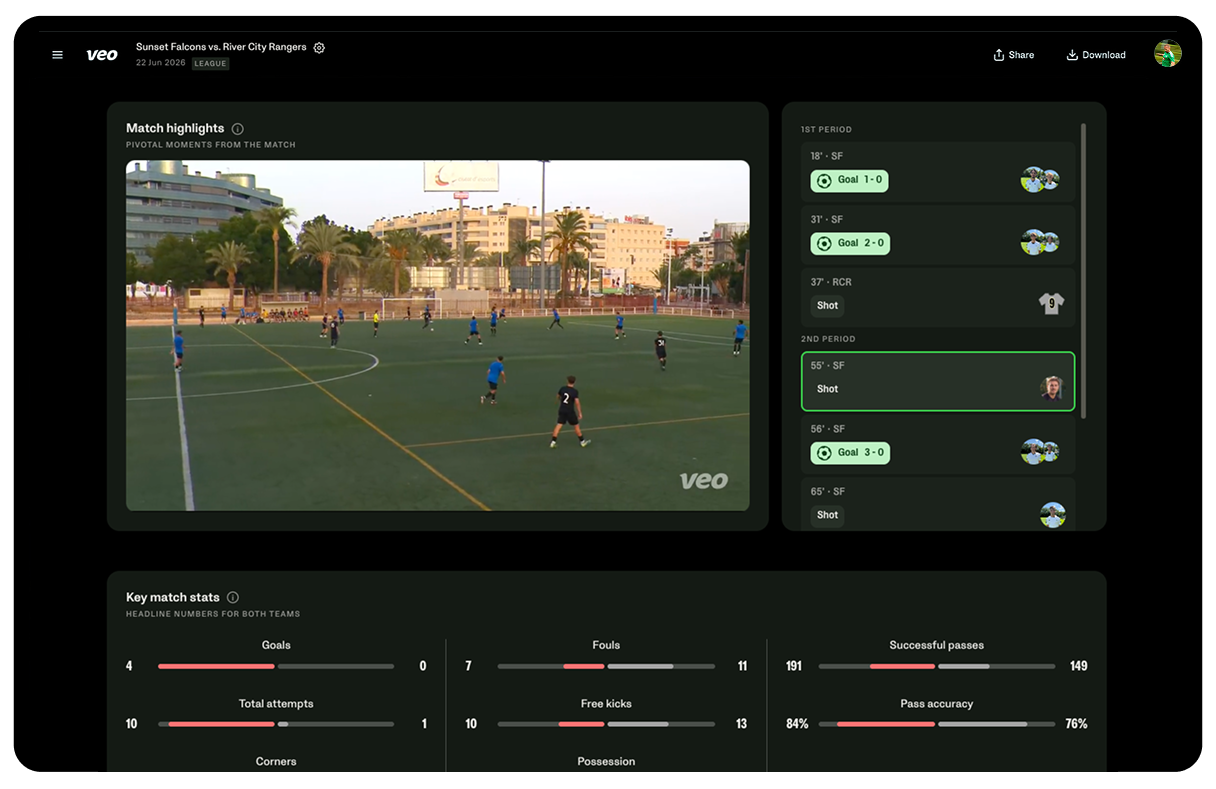
Veo is an AI-powered sports camera that records matches and training sessions automatically, without requiring a dedicated camera operator. Footage is automatically uploaded after the session, and players and coaches can access, clip, and share recordings immediately on the platform. For a club run largely on volunteer time, the fact that the camera operates without someone behind it matters.
Live streaming is the next step
Worcester City Women's next steps with video are set clearly. Live streaming for fans who cannot travel to away games. More content on YouTube. And, most significantly, the launch of a youth academy structure over the next 18 months.
The academy piece is the one Allison describes with most energy. Worcester lacks a talent pathway for young female players. Talented 14-year-olds currently have to leave the county to access one. What she is building is the structure that keeps them close to home and gives them a route to the first team.
"When we develop our youth structure, it will be very similar to what I did when I launched the club," she says. "We are providing you and investing in video and tech. You are going to use this. You don't just get to be a player who turns up on a Saturday morning and forgets about it after. You need to actually commit to developing yourself, because that's what the coaches are doing, and that's why the club is investing in you. Which some people either get on the bus, or they don't."
At the first team level, the same principle already applies to players in the reserves who train once a week with the senior squad. Video is the next layer to add to that integration.
"We've only really scratched the surface," Allison says. "Video is going to be crucial, and we know we've got a lot more to unlock."



.jpeg)