Best Camera for Youth Football: A Practical Guide
Frederik Hvillum
.jpg)
How to choose the best camera for filming youth football. Static vs AI-powered, what to look for, and why setup simplicity matters more than specs.
The best camera for youth football is the one that gets used every match. It does not need to be the most expensive option or the one with the longest spec sheet. It needs to be simple enough to set up reliably, produce footage wide enough to be useful for coaching, and fit into the budget and routine of a volunteer-run club.
This guide covers the four main options coaches and clubs use to film youth football matches, what each one does well, where each one falls short, and how to decide which is right for your situation. It applies to both soccer and American football.
Film every match automatically with Veo Go
Veo Go sets up in under 2 minutes, tracks the action automatically, and uploads footage to the platform for review the same evening. No operator needed.
.jpg)
What to look for in a youth football camera
Most buying guides for sports cameras focus on resolution, frame rate, and lens specifications. Those things matter less than coaches expect. The footage from a 1080p camera positioned correctly is more useful for coaching than 4K footage from the wrong angle. Four things matter more than specs:
- Field of view. The camera needs to capture enough of the pitch to see player movement off the ball. A tight zoom on the action is less useful than a wide view that shows shape and positioning.
- Setup simplicity. A camera that takes 20 minutes to set up does not get set up consistently. Coaches managing a warm-up and a team sheet at the same time need a setup they can complete in under 5 minutes.
- Battery life. Youth matches run between 50 minutes and 90 minutes depending on age group. The camera needs to last the full match without requiring a mid-game battery swap.
- Footage accessibility. Footage that sits on a memory card and never gets shared has no coaching value. How easy is it to get clips from the camera to your players the same evening?
The four main options compared
Option 1: Action camera on a fixed mount
Action cameras mounted at height on a fixed tripod produce a wide-angle view of the pitch without requiring a human operator. The camera records continuously and captures everything in the fixed frame throughout the match.
The limitation: a fixed wide angle does not follow the play. When the game moves to the far end of the pitch, players appear small and details are hard to identify. For large pitches at U12 and above, a fixed action camera captures the shape of play but loses individual technical detail.
Best for: coaches who want a no-fuss setup and are primarily interested in team shape and formation rather than individual technique.
Option 2: Dedicated sports camera with operator
A dedicated sports camera on a full-height tripod, operated by a parent or assistant coach, produces the most flexible footage. The operator can zoom in on individual situations, follow set pieces, and frame the shot actively throughout the match.
The limitation: it requires a reliable operator at every match. Parent volunteers miss matches, lose concentration, and zoom in on the wrong situations. The quality of the footage varies as much as the operator does. Over a season, this becomes a significant inconsistency.
Best for: clubs with a committed parent or assistant who enjoys filming and attends every match reliably.
No operator. No missed matches.
More than 40,000 clubs across 100 countries use Veo to store and share footage, with over 4 million matches filmed on the platform (Veo internal data, 2026). Veo Go tracks the action automatically so the coach can focus on the game.
.jpg)
Option 3: Veo Go
Veo Go uses AI to track the action automatically throughout the match. The coach sets up the camera once, positions it at the midfield line, and leaves it to record. The camera follows the play without a human operator, capturing full-pitch coverage across the full match.
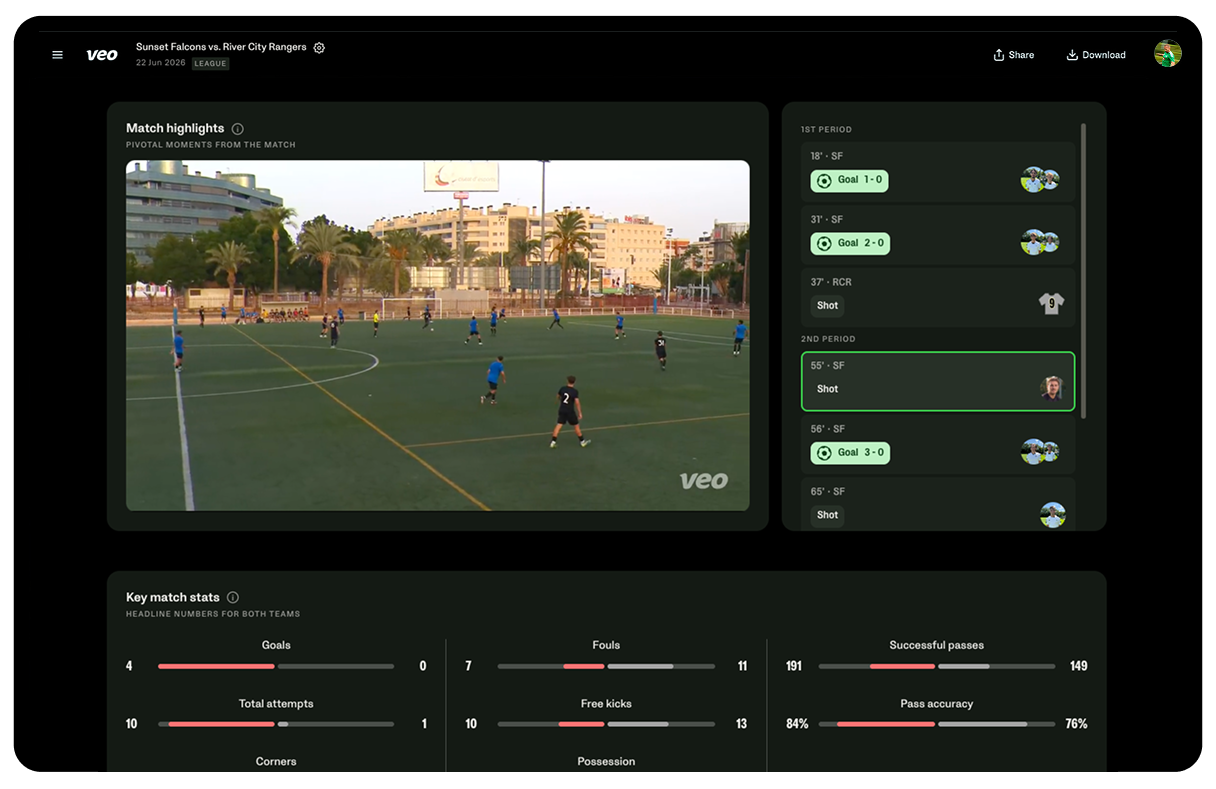
Footage uploads to the Veo platform automatically after the match and is available for review the same evening. Coaches can clip individual moments, share them with players and parents, and build a library of match footage across the full season.
The limitation: it requires a subscription and a reliable internet connection for upload. For clubs filming every match across multiple age groups, the cost per match drops significantly compared to one-off camera purchases.
Best for: clubs that want consistent, automatic, full-match footage without relying on a human operator at every game.
For a deeper look at auto-tracking camera options specifically, see best auto-tracking camera for youth football.
How to decide which option is right for your club
Budget is tight and filming is occasional
Start with a smartphone and a full-height tripod. Keep the camera fixed at the midfield line and accept the limitations of a static view. For occasional filming, this produces footage that is useful enough for post-match review without any additional cost.
You want to film every match but cannot spare an operator
An AI-powered camera is the right choice. The fixed-camera alternative produces footage that loses detail at distance. If filming every match matters, the consistency of automatic tracking justifies the cost over a season.
You have a reliable volunteer who attends every match
A dedicated sports camera with a committed operator produces flexible, high-quality footage. Invest in a camera with good optical zoom and a stable tripod. Give your operator a briefing on framing: wide view by default, zoom only for set pieces and individual situations.
For the full setup guide regardless of which camera you choose, see how to film youth matches. For how to use footage as part of your match day routine, see youth football game day preparation.
.jpg)
Try Veo Go for your next match
Set up in under 2 minutes. Full-match footage ready to share the same evening.

FAQs
Yes, with two approaches. A fixed wide-angle camera records continuously without anyone touching it, but misses detail at distance. An AI-powered camera like Veo Go tracks the action automatically, producing footage comparable to a human operator without requiring one at the pitch
No. A smartphone on a stable tripod at the right position produces useful coaching footage. The most important factor is camera position and height, not camera quality. That said, AI-powered cameras designed for sports filming solve the operator problem that limits most manual setups.
With a standard tripod and camera, allow 10 to 15 minutes including finding the right position and recording a test clip. With Veo Go, setup takes under 2 minutes. Either way, arriving before players do makes setup straightforward. Trying to set up while managing pre-match preparation leads to missed kick-offs and poor camera positioning.
At the lowest end, a smartphone you already own and a tripod (from around 30 to 60 GBP) covers the hardware cost. AI-powered cameras like Veo Go involve a hardware cost plus a subscription. For clubs filming multiple teams across a full season, the cost per match of a subscription-based system is often lower than the ongoing cost of maintaining manual filming equipment.
Midfield line, elevated to at least 3 metres using a full-height tripod, with a slight downward angle so both touchlines are visible. This position captures team shape, individual positioning, and enough detail to identify technique errors. A camera too close to the pitch cuts players off at the edges; a camera too far back loses individual detail.
The best camera is the one that gets used consistently. For clubs without a reliable operator, an AI-powered camera like Veo Go produces automatic full-pitch coverage without human intervention. For clubs filming occasionally, a smartphone on a full-height tripod at the midfield line produces footage sufficient for coaching review.

.jpeg)