Youth Football Passing Drills: A Complete Coaching Guide
Frederik Hvillum

The best passing drills for youth football coaches. Short passing, combination play, switching play, and passing under pressure, with age guidance and coaching cues.
Passing is the most frequently used skill in football. A player who passes accurately under pressure, at the right weight and to the right foot, gives their team a platform to build from. A player who misplaces passes under pressure gives the ball away at the moments that matter most.
This guide covers five passing drills for youth football coaches, progressing from basic accuracy work to passing under pressure and decision-making in game-realistic situations. Each drill includes coaching cues, age guidance, and notes on what video review reveals that live coaching misses.
Are you looking to improve your football skills? Find 8 drills to improve your game here.
Record your passing drills with Veo Cam 3
Veo Cam 3 sets up in under 2 minutes and records your full session automatically. Review pass weight, movement off the ball, and decision-making the same evening.
What good passing actually requires
Most coaches focus on the technical side of passing: foot position, contact point, follow-through. Those things matter. What matters equally is the decision that precedes the pass: when to play a short ball to feet, when to switch the play, when to play into space rather than to a player. Players who pass technically well but decide slowly are easy to press and easy to defend.
The drills below develop both. They start with accuracy and weight of pass in low-pressure situations and build toward passing decisions under pressure in game-realistic formats. For how to integrate these drills into a full session structure, see the youth football practice guide linked in the related reading section below.
Drill overview
The drills
Drill 1: Gate passing
Set up pairs of cones approximately 1 metre apart to create gates, scattered across a 20x20 metre area. Players work in pairs, passing through as many different gates as possible in 8 minutes. The passer moves to a new gate after each pass; the receiver controls and finds a new gate to pass back through. No repeating the same gate twice in a row.
Coaching cue: "Weight of pass matters as much as direction. A pass that reaches your teammate too fast or too slow makes control harder. Think about where they are moving, not just where they are standing."
Age note: Appropriate for all ages. At U6 to U8, widen the gates to 2 metres and allow two touches. The movement element keeps players active and introduces the concept that passing involves repositioning, not standing and waiting.
Drill 2: Triangle combination
Three players set up in a triangle approximately 8 metres on each side. Player A passes to Player B and runs to take Player B's position. Player B plays a one-two with Player C and moves to take Player C's position. Player C plays a first-time pass to where Player A has moved. The sequence continues for 10 minutes. Players focus on timing the run so they arrive as the ball arrives.
Coaching cue: "Pass and move are one action, not two. The run starts as the ball leaves your foot. If you wait to see where the ball goes before you move, you are already too late."
What to watch on video: Timing of the run relative to the pass. Players who move after the pass rather than with it are visible immediately in the footage. The triangle format also shows whether players are checking their shoulder before receiving.
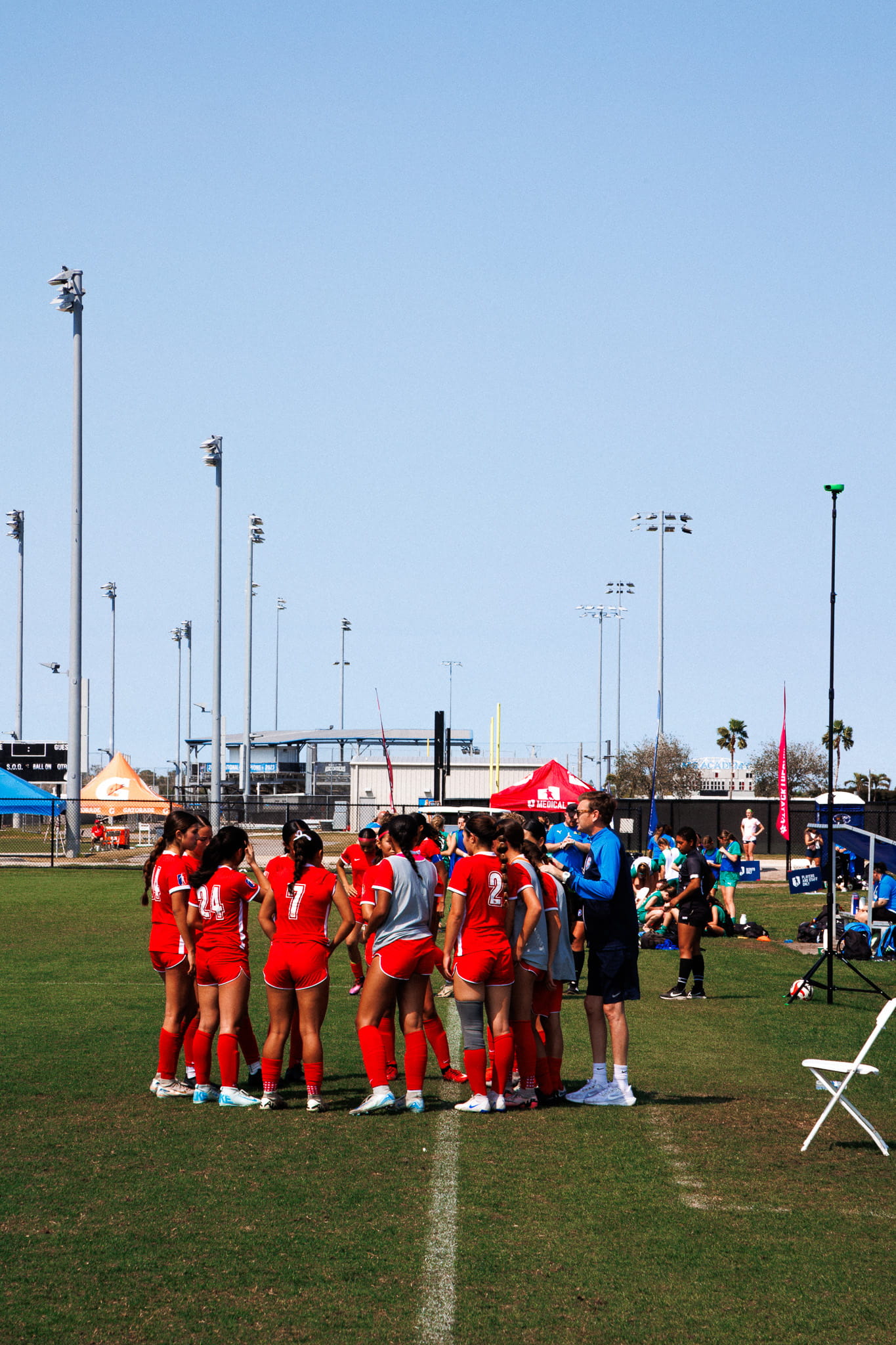
Review movement off the ball in slow motion
More than 40,000 clubs across 100 countries use Veo to store and share footage, with over 4 million matches filmed on the platform (Veo internal data, 2026). Veo Cam 3 captures the full training area so you can review pass timing and movement off the ball in detail.
Drill 3: Switching play drill
Set up a 40x20 metre area divided into two halves by a central line. Four players work in each half: three attackers and one defender. The attackers keep possession in their half. On the coach's signal, one attacker must switch the ball into the opposite half with a long pass to a teammate who has made a run across the central line. The defending player can press the long pass but cannot cross into the other half.
Coaching cue: "Before you switch, check that your teammate is ready to receive. A switch pass to a player who is not moving is easier to defend than one played into the run."
Age note: Introduce at U10. Switching play requires players to scan and identify space on the far side of the pitch, which is a tactical concept that needs physical and cognitive development to be teachable.
Drill 4: 3v1 rondo
Three players form a triangle approximately 6 metres on each side. One defender works in the middle. The three attackers keep possession using one or two touches. When the defender intercepts or forces the ball out, the player who gave it away goes into the middle. Run continuously for 10 minutes.
Coaching cue: "Receive on the back foot. Open your body before the ball arrives so you can see both passing options. A player who receives square-on has to take an extra touch to play forward."
What to watch on video: Body orientation at the moment of receiving. Players who receive with a closed body shape take one more touch than necessary before every pass, which means they are always a step behind the pace of play. This is one of the most common and most correctable habits in youth football.
Drill 5: Passing to feet vs space
Set up a 30x20 metre area with two teams of four and small goals at each end. Normal small-sided game rules apply, with one additional condition: attackers must call "feet" or "space" before each pass to communicate their intention to their teammate. If no call is made, the pass does not count and possession is given to the other team. The constraint forces players to make explicit decisions about pass type rather than playing the most comfortable option.
Coaching cue: "Space passes are for players who are running. Feet passes are for players who are checking back. If your teammate is not moving, do not play it into space and expect them to chase."
Age note: Introduce at U10. The verbal call requirement is uncomfortable at first and slows the game down initially, which is intentional. Once the decision-making becomes instinctive, the call requirement can be removed.
How video makes passing coaching more effective
The most common passing errors in youth football are invisible at full speed: a body position that is slightly closed, a pass released a touch too late, a run timed just after the ball rather than with it. These details show clearly in slow-motion footage and are very difficult to identify and communicate in real time.
Coaches using Veo Cam 3 record training sessions and review footage before the next session. Clips from the triangle combination showing passes released too late, or footage from the rondo showing body orientation errors, become the starting point for the next session's coaching.
For the full range of drills that complement these passing sessions, see youth football passing drills. For how to set up your camera at training, see how to film youth matches.
Record every session. Review every week.
Veo Cam 3 sets up in 2 minutes and records automatically. Full session footage ready to review the same evening.

FAQs
Gate passing develops accuracy and weight of pass. Triangle combinations develop movement off the ball and one-two passing. The 3v1 rondo develops passing under pressure and body orientation on receiving. All three should feature regularly in youth football sessions because they target the most common passing errors at youth level.
Start with accuracy before pressure. Gate passing at close range builds correct contact and weight without introducing a defender. Once accuracy is consistent, introduce pressure through rondos where a defender forces quicker decisions. Finally, introduce game-realistic formats like the passing to feet vs space drill where decisions must be made in the context of actual play.
Yes. Body orientation, pass timing, and movement off the ball are all easier to identify and correct from video than from real-time coaching. A player who watches themselves receiving with a closed body shape and then watches a clip of correct body orientation makes the adjustment in the next session. Verbal descriptions of the same correction take significantly longer to translate into changed behaviour.
Receiving with a closed body shape is the most common and most consequential. A player who receives square-on to the passer cannot play forward without an extra touch. That extra touch gives defenders time to press and reduces the team's ability to play quickly. Teaching players to open their body before the ball arrives is the single most effective passing coaching intervention at youth level.
Introduce switching play from U10. Players need to be able to scan and identify space on the far side before a switch pass makes sense. At U8, keep the focus on short passing and movement. At U10, introduce switching play in a constrained format like the drill above before introducing it in a full game context.