How to Get Noticed by College Coaches Using Video [2026 Guide]
Veo

How to use video to get noticed by college coaches and scouts. What to film, how to build a highlight reel, what to write in outreach emails, and how to share your Veo footage.
College coaches cannot attend every game. A Division I soccer coach who recruits nationally might watch a player live once or twice before making a scholarship offer. The rest of the evaluation happens on video. An athlete who understands this and builds a strong video presence gives themselves access to coaches who would never see them otherwise.
This guide covers the complete process from what moments to capture on film, to how to build a highlight reel, to what to write in an email to a college coach. Every step is designed for athletes and parents who want to do this themselves, without paying for a recruiting service. For a detailed guide on what to include in the video itself, see how to create a college recruiting video.
What college coaches are actually looking for on film
Before filming anything, understand what the footage needs to answer. College coaches evaluate film by asking three questions:
- Can this player compete at my level? Physical profile, speed, athleticism, and intensity relative to the competition they are playing against. Coaches can tell within 30 seconds whether a player is physically plausible for their program.
- Does this player make good decisions? Positioning, awareness, movement off the ball, and execution under game pressure. Decision-making separates players with similar physical profiles.
- Will this player fit my program? Work rate, reaction to mistakes, how they treat teammates, competitive character. This shows up in game film when a player does not know the camera is watching.
Every clip you include should answer at least one of these questions. Clips that show only technical skill without game context answer only the first question and leave the other two unanswered.
What moments to capture on film
The most valuable clips come from game situations, not training drills. Here is what to look for in your footage:
Defensive sequences
A full defensive sequence of 20 to 40 seconds shows more about a player than any skill highlight. Starting from the moment the opposing team has the ball, through the player's positioning, pressing decision, recovery run, and final action. Coaches who recruit at competitive levels know that defending is the most reliable indicator of coachability and work ethic.
What to capture: Pressing decisions, defensive tracking runs, positioning relative to ball and opponents, winning 50/50 balls, recovery after losing possession.
Off-ball movement
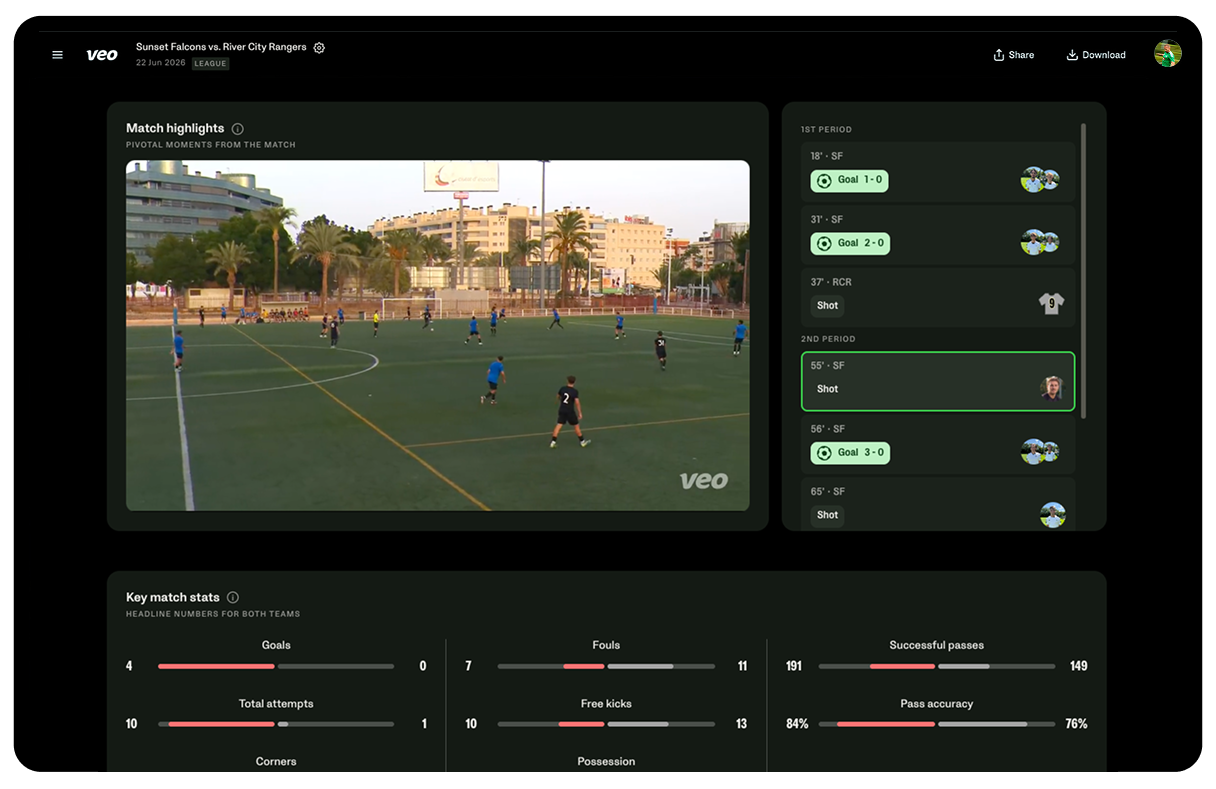
Off-ball movement is invisible to most live observers because their attention follows the ball. The wide-angle panoramic view from Veo footage shows exactly what a player is doing when they do not have the ball. A player who makes intelligent runs, holds good width, and creates space for teammates stands out clearly in full-field footage.
What to capture: Runs into space, positioning before receiving the ball, creating angles for teammates, holding shape defensively without the ball.
Decision-making under pressure
Clips that show a player receiving the ball in a tight situation and making the right decision quickly tell coaches something about game intelligence. A first-time pass under pressure, a composed turn with a defender close, or a quick switch of play under a press are all evidence of high football IQ.
What to capture: Quick decisions on and off the ball, execution under pressure, situations where the correct choice was not the obvious one.
Athleticism in game situations
Speed and athleticism clips are most convincing when they come from game situations rather than timed drills. A burst of acceleration to win a footrace, a jump to contest an aerial ball, or a rapid change of direction to beat a press are all athletic demonstrations that are harder to fake than a timed sprint.
More than 40,000 clubs use Veo to build recruiting libraries
More than 40,000 clubs across 100 countries use Veo to store and share footage, with over 4 million matches filmed on the platform (Veo internal data, 2026).

This structure works for most field sports with minor adjustments. For basketball, replace defensive sequences with transition defence and half-court positioning clips. For lacrosse, replace the athletic clip with a ground ball or face-off sequence. The principle remains the same: game film first, then athleticism, then skill highlights.
How often to send film and what to write
Most athletes send one email and wait. College coaches receive dozens of messages per week. A single email without a follow-up is unlikely to produce a response. The outreach process requires consistency and professionalism over time.
Initial outreach email
Keep the first email under 150 words. College coaches decide in seconds whether to click a link. The email should contain:
- One sentence introducing who you are. Name, position, graduation year, club team, and academic standing.
- One sentence on why you are contacting this specific program. Reference something specific about the program, not a generic compliment.
- A direct link to your Veo footage or highlight reel. Not an attachment. A direct link that plays in any browser.
- A brief line on what the footage shows. For example: I have linked 90-second highlights focused on my defensive work and off-ball movement.
- Your contact information and your club coach's contact information. Coaches verify through club coaches.
Follow-up schedule
Send a follow-up every four to six weeks. Each follow-up should add new information: an updated clip from a recent game, a tournament result, an improvement in your stats. Never send the same message twice. Coaches remember athletes who show consistency and development, not just those who send the most emails.
What not to write
- Generic openers. "I have always dreamed of playing for your program" tells the coach nothing. Specific research into their team tells them you are serious.
- Long emails. Over 200 words will not be read in full. Every sentence should earn its place.
- Attachments. Large video files via email get caught in spam filters or ignored. Always share via a direct link.
- Only messaging on social media. Email is the professional channel. Social media messages can supplement email but should not replace it.
How to share your Veo footage with coaches
Veo footage is shareable via a direct link that plays in any browser. No app download required, no file to transfer, no format compatibility issues. Share the link in an email alongside a brief description of what the footage shows.
Three ways to share:
- Full game link. Share access to a complete game when a coach requests full film. Coaches who are seriously interested will ask for this to evaluate consistency across 90 minutes.
- Highlight reel link. A trimmed three to five minute reel for initial outreach. Built from Veo clips in the Veo Editor.
- Individual clip link. A 30 to 60 second clip of a specific moment for targeted follow-up. If a coach mentioned they are looking for a holding midfielder, send a clip that directly addresses that position.
For a complete breakdown of the costs involved in building a recruiting video, see how much does a college recruiting video cost.
Parent checklist: before sending film to a coach

FAQs
The most reliable path is consistent, high-quality game footage shared directly with coaches via email. College coaches evaluate most players on video before they attend a game in person. An athlete who films every game automatically, builds a highlight reel focused on decision-making and off-ball movement, and reaches out to specific programs with a direct link gets evaluated on merit rather than on whether a coach happened to attend their game.
College coaches evaluate physical profile, decision-making, and character. Physical profile is established quickly. Decision-making is what separates similar athletes. Character shows in how a player responds to mistakes, how they treat teammates, and whether they compete at the same intensity throughout the game. All three are visible in game film.
Keep the email under 150 words. Include your name, position, graduation year, club team, and academic standing. Reference something specific about their program. Include a direct link to your video footage. Add your contact information and your club coach's contact details. Follow up every four to six weeks with new footage or updated information.
Most college coaches begin evaluating players in their sophomore and junior years of high school. Starting to film consistently at 14 or 15 means a player has a two to three year library ready when recruiting conversations begin. Early footage also shows a player's development trajectory, which coaches find as compelling as current level.
Record every game using Veo Go or Veo Cam 3 from a consistent camera position. After each game, identify two or three strong clips in the Veo platform and tag them. Over a season, this builds a complete library. When ready to share, use the Veo Editor to build a three to five minute highlight reel and share it via a direct link. Full game film is available to send to any coach who requests it.


.jpeg)