Base Running Drills for Youth Baseball: A Coach Guide
Veo
%20(1).jpg)
The best base running drills for youth baseball coaches. First step, rounding bases, reading the ball, and stealing, with age guidance and coaching cues for each drill.
Base running is the most undertrained offensive skill in youth baseball. Most coaches spend practice time on hitting and fielding, and base running is addressed during scrimmages when mistakes happen rather than as a dedicated skill with its own drill time. The result is teams that leave runs on the base paths every game because players do not know when to run, how to round bases efficiently, or how to read the ball off the bat.
This guide covers five base running drills that develop the habits youth players need most. Each drill includes coaching cues, age guidance, and notes on what video review reveals that live coaching misses.
What base running actually requires
Good base running is built on three habits: an explosive first step out of the box, correct rounding technique on extra-base hits, and the ability to read the ball off the bat. Players who have all three create pressure on defences that players who simply run hard in a straight line do not.
None of these habits develop during scrimmages. They require isolated repetition in dedicated drills. For the full practice structure that these drills sit within, see the youth baseball coaching tips guide.
Drill overview
The drills
Drill 1: First step out of the box
Players line up in the batter's box. On the coach's signal (a clap or verbal "go"), each player takes their first two steps out of the box and sprints through first base. No bat, no ball. The focus is entirely on the first step: it should cross toward first base immediately, not go backward or sideways. Run 5 reps per player. Time the run from the signal to first base and track improvement across sessions.
Coaching cue: "Run through the base. Your speed at first base should be higher than your speed before it. If you are slowing down to hit the bag, you are giving the defence extra time."
Age note: Appropriate for all ages. At U6 to U8, remove the timing element and focus only on the direction of the first step and running through the base rather than to it. These two habits alone prevent most of the baserunning errors that occur at youth level.
Drill 2: Rounding bases drill
Players start at home plate and sprint toward first base. As they approach first, they take a banana route: a slight arc that positions them to hit the inside corner of the bag with their right foot and round toward second without breaking stride. Continue to second, round it with the same technique, and stop. Reset and repeat. Run 4 reps per player. Focus on the route to first, not the speed between bases.
Coaching cue: "Start your arc before you reach the base. If you run straight at first and then try to round it, you have to slow down. The arc starts 10 metres before the bag."
What to watch on video: The angle of the approach route and which foot hits the base. Players who run straight at first and then veer left hit the outside corner of the bag, which slows them down and forces an awkward angle to second. A camera positioned from the third base line shows the approach angle clearly.
See rounding angles and first step mechanics in detail
More than 40,000 clubs across 100 countries use Veo to store and share footage, with over 4 million matches filmed on the platform (Veo internal data, 2026). Veo Go captures base running mechanics from multiple angles so coaches can identify route inefficiencies before they cost runs in games.
Drill 3: Reading the ball off the bat
A runner stands on first base. The coach stands at home plate and either hits a ground ball or a fly ball to different fielder positions. The runner reads the ball and makes a decision: advance on a ground ball through the infield, hold on a line drive, tag up on a deep fly ball. The coach calls out whether the decision was correct after each rep. Run 10 reps per runner with a mix of ball types and locations.
Coaching cue: "Read the ball, not the fielder. By the time you see the fielder move, it is too late to make the right decision. Watch the ball leave the bat and make your decision in the first second."
Age note: Introduce at U10. Reading the ball off the bat requires players to track ball flight, assess fielder positions, and make a decision simultaneously. At U8, simplify to two situations only: run on a ground ball through the infield, hold on everything else.
Drill 4: Secondary lead drill
A runner stands on first base. The coach stands on the mound and simulates a pitching motion. As the coach's arm passes the hip (the release point), the runner takes two shuffle steps toward second: this is the secondary lead. The runner freezes at the end of the secondary lead and the coach calls whether the timing and distance were correct. Run 8 reps. The secondary lead is the habit that gets runners into scoring position on passed balls and wild pitches.
Coaching cue: "Two shuffle steps, not a sprint. You are gaining ground while staying in control. If you overrun your secondary lead, you cannot get back on a pickoff attempt."
Age note: Introduce at U10. Secondary leads require players to time their movement to the pitching delivery, which is a cognitive skill that develops from this age. At U8, focus on primary lead distance and the first step out of the box before introducing secondary lead timing.
Drill 5: Tag-up drill
A runner stands on third base. The coach or a fungo hitter hits a fly ball to the outfield. The runner watches the ball, keeps contact with the bag until the ball is caught, and then breaks for home as aggressively as possible. Vary the depth and location of the fly ball: shallow, medium, and deep. Run 6 reps. The coaching focus is on reading depth correctly: tagging on a shallow fly ball produces an out, while hesitating on a deep fly ball wastes a scoring opportunity.
Coaching cue: "Get your secondary lead while watching the ball. The moment it is caught, your back foot pushes off the bag. If you wait to see the catch before you start moving, you have lost a step."
Age note: Introduce at U10. Tag-up decisions require players to read fly ball depth and outfielder arm strength simultaneously. At U8, simplify to tagging on deep fly balls only and holding on all others.
Using video for base running development
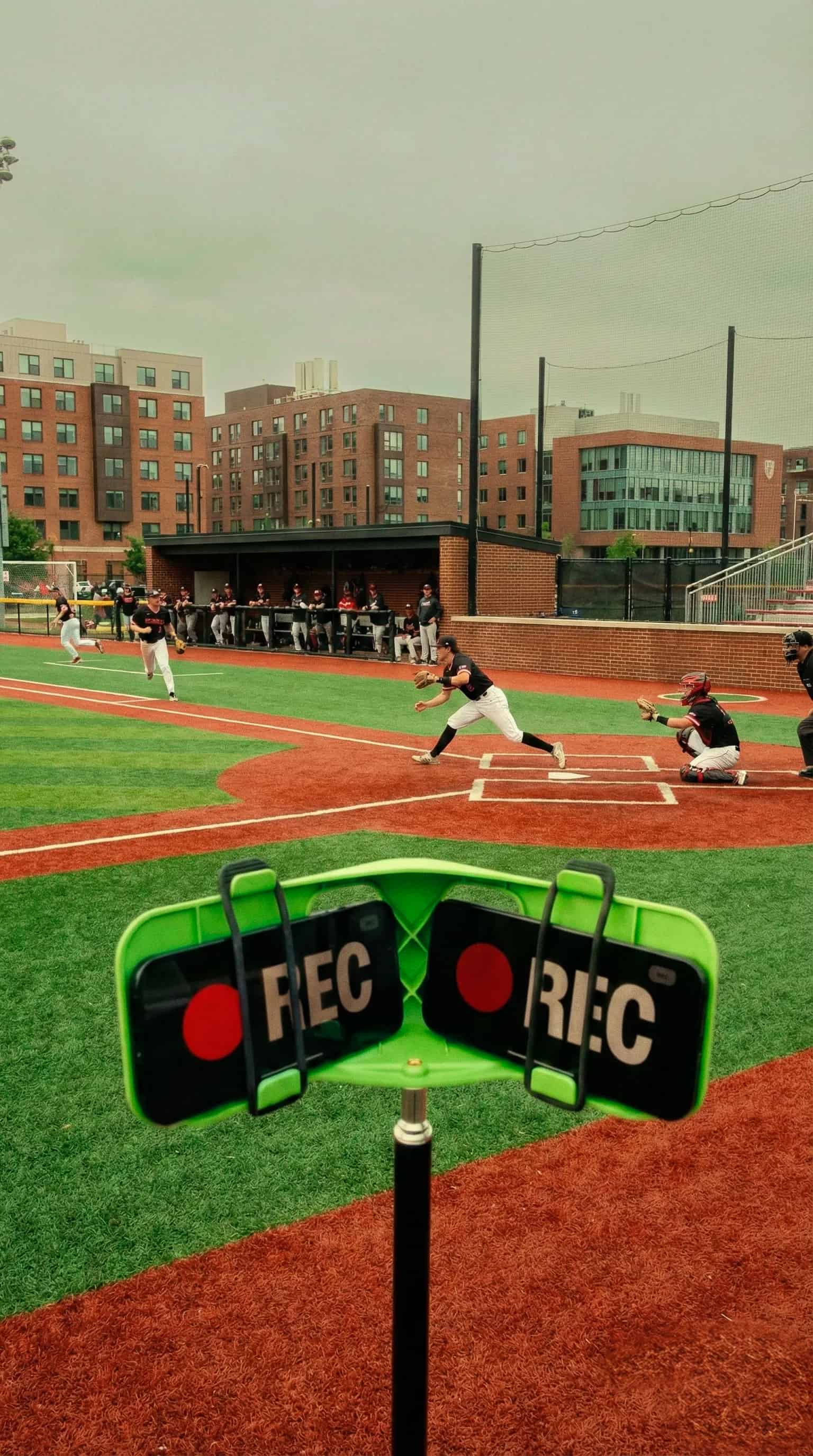
Base running mechanics are very difficult to coach accurately from the dugout. The coach's view is often obscured, and base running decisions happen in real time under game pressure. Video footage from a fixed position behind third base or from an elevated angle shows approach routes, foot position on the bag, and secondary lead timing clearly.
Coaches using Veo Go review base running footage after practice and identify the two or three mechanical habits most worth addressing. Rounding angle errors and secondary lead timing are both visible immediately in the footage and produce faster improvement when players watch themselves than when they receive only verbal feedback. For outfield drills that complement base running development on the defensive side, see baseball outfield drills.

FAQs
The first step out of the box drill and the rounding bases drill are the two most important base running drills at any age because they build the foundational habits that every other base running skill depends on. Reading the ball off the bat develops the decision-making that turns singles into doubles. All three should be in every base running practice.
Start with the banana route approach before introducing any game-speed running. Players walk through the arc at first base, focusing on hitting the inside corner of the bag with their right foot. Once the route pattern is understood, build to jogging speed, then game speed. The arc should start approximately 10 metres before the base. Players who learn to round bases correctly at U8 carry the habit through every level they play.
Yes. Rounding angles, foot contact on the base, and secondary lead timing are all easier to identify from video than from the dugout. A camera positioned down the third base line or from an elevated angle behind home plate captures the approach route and base contact clearly. Players who watch themselves running a straight line at first base and then attempting to round it understand the problem immediately.
Introduce basic base running decisions from U10. Start with two clear rules: run on a ground ball through the infield, hold on a fly ball until it drops or is caught. Add the secondary lead and tag-up from U10 to U12 as players develop the cognitive capacity to track multiple pieces of information simultaneously. At U8, focus on first step mechanics and running through first base before introducing any situational decision-making.
The secondary lead is the two shuffle steps a baserunner takes toward the next base as the pitch is delivered. It is taken after the pitcher's arm passes the release point, meaning the runner is moving as the ball crosses the plate. A good secondary lead puts runners in a position to advance on passed balls, wild pitches, or balls in the dirt without having to make a full running start from a standing position.


%20(1).jpg)