The 20-Minute Post-Match Video Review Session That Actually Works
Frederik Hvillum
.jpg)
Learn how to run a post-match video review session that improves performance. A step-by-step guide for coaches who want feedback that actually lands.
A post-match video review session is a structured process where a coach and players watch recorded match footage together to analyse performance, identify patterns, and set clear priorities for the next training session or game.
Done well, it is one of the most powerful development tools available to any coach at any level. Done poorly, it becomes a 45-minute presentation that players forget before they reach the car park.
This guide covers the full process: when to review, what to look for, how to structure the session, and how to keep it short enough to actually be useful.
What separates a video review session that changes behaviour from one that doesn't?
The problem is rarely the footage. It is the gap between watching and doing.
Coaches often run review sessions as a demonstration of what went wrong. Players sit, watch, and nod. But watching errors without a clear framework for what comes next rarely produces lasting change.
There is also a timing problem. Players walk off the pitch with their own version of events in their heads. They felt confident in a decision that looked wrong on screen. They believe they tracked their runner. They were sure the pass was on.
Verbal feedback enters that version of events and negotiates with it. The conversation becomes about what happened rather than what to do differently. Video removes the negotiation. The player sees themselves and draws the conclusion themselves, which is the only conclusion that tends to stick.
The second failure mode is length. A 45-minute review session with 30 clips is not more thorough than a 20-minute session with five clips. It is less effective. Attention falls off. The teaching points blur together. Players leave having watched a lot of footage and retained almost none of it.
Short, focused, and consistent beats long, comprehensive, and occasional every time.
.jpg)
What should you do in the hour after the final whistle?
Before you open any footage, step away from it.
Immediately after a game, the emotional noise is too loud for useful analysis. You are irritated about the goal you conceded in the last ten minutes. You are replaying the tactical decision that went wrong in the second half. You are carrying the result.
That state produces review sessions that are really about releasing frustration rather than improving players.
Instead, take ten minutes with your coaching staff while the dressing room is clearing. Ask three questions and write down the answers:
1. What did we do well that we want to reinforce?
2. What went wrong that we need to address?
3. What is the one thing we want players to focus on before the next game?
These answers become your brief for the footage review. When you sit down with the video later that evening, you are watching with intention rather than searching for confirmation of what already bothered you.
If you coach alone, record a voice note on the drive home. The goal is to enter the footage with a hypothesis, not a grievance.
When should you review the footage?
The same night, if possible. Certainly before the next training session.
The closer the review is to the performance, the more connected players are to the specific moments on screen. They remember the situation. They remember what they were thinking. The feedback lands in context rather than arriving as an abstract comment about a game that already feels distant.
For coaches who play multiple times a week, same-night review is not optional. It is the only workflow that keeps the cycle from collapsing. Three games a week means three review windows. If you wait until the weekend to process Tuesday's match, the tactical moment has passed and the players have mentally moved on.
Short cycles, run consistently, compound across a season. A coach who runs ten minutes of focused review after every game will develop their squad faster than one who runs an hour-long session once a fortnight.
What footage should you prioritise?
Select clips that reflect your team's tactical identity. If you build from the back, every review should include moments that show how well you executed that structure, both when it worked and when it broke down. If you press high, look at the trigger moments and whether players responded to them.
As a general framework, select clips across three areas:
Defensive organisation. Transition moments, pressing triggers, shape when out of possession, second-ball reactions.
Offensive execution. Build-up patterns, movement off the ball, shot creation sequences, set-piece delivery and runs.
Individual moments. One clip per review directed at a specific player. Keep it respectful and specific. Address it directly.
On all three: show what went well alongside what needs improvement. This is not a courtesy. It is the mechanism by which players stay engaged with the process. A player who only sees their mistakes on screen eventually stops watching. A player who sees themselves doing something well, clearly labelled as such, builds that behaviour into habit.
The same logic applies to players who are hard on themselves. Footage lets you show a player that their self-assessment is wrong. You cannot argue someone out of their own self-perception. You can show them evidence that contradicts it.
How do you structure a 20-minute review session?
Minutes 0 to 3: Open with a positive. Start with one clip that shows something your team did well. Name what you are about to show before you show it. "We're going to look at how we pressed from the front in the second half. Watch what the number seven does when the goalkeeper has the ball." Give players something to look for before the clip runs.
Minutes 3 to 14: Two or three teaching clips. Show each clip once. Pause. Ask a question before giving the answer. "What do you notice about the shape here?" Wait for responses before explaining what you saw. This turns passive watching into active analysis. The player who speaks a coaching point out loud retains it better than the player who hears it.
Minutes 14 to 18: One individual clip. Address one player or unit directly. Keep it brief and specific. "Here's the moment we talked about at half-time. Watch the defensive midfielder's first step when the ball goes wide."
Minutes 18 to 20: One action point. End with a single sentence that connects the review to the next session. "On Thursday we're working on our press trigger. You've just seen why." Close there. Do not summarise the match. Do not revisit every mistake. End with purpose.
How do you use footage for individual development outside of group sessions?
The most effective use of match footage often happens outside the review session entirely.
When footage is available the same evening, a coach can identify the clips relevant to a specific player and have that conversation one-to-one the next day, at training or at lunch. The feedback is specific, timely, and impossible to argue with. The player sees exactly what happened. The conversation starts at a different point: not whether the problem exists, but what to do about it.
For players in the middle of a difficult run of form, this kind of individual clip review can shift something that group sessions cannot reach. The player is not watching alongside teammates. There is no social pressure in the room. The conversation is between coach and player, and the footage is the only authority in it.
The same principle applies across the season. Early in the year, the focus is on your own team's development patterns. As the competition intensifies, the same footage workflow applies to scouting opponents. The process scales without changing its structure.
How does AI camera technology change what is possible without analyst support?
The practical barrier for most coaches has never been motivation to review footage. It has been the time required to produce usable clips.
Traditional workflows meant hiring a videographer, burning DVDs, or spending hours cutting footage manually before the next training session. By the time the clips were ready, the tactical window had often closed.
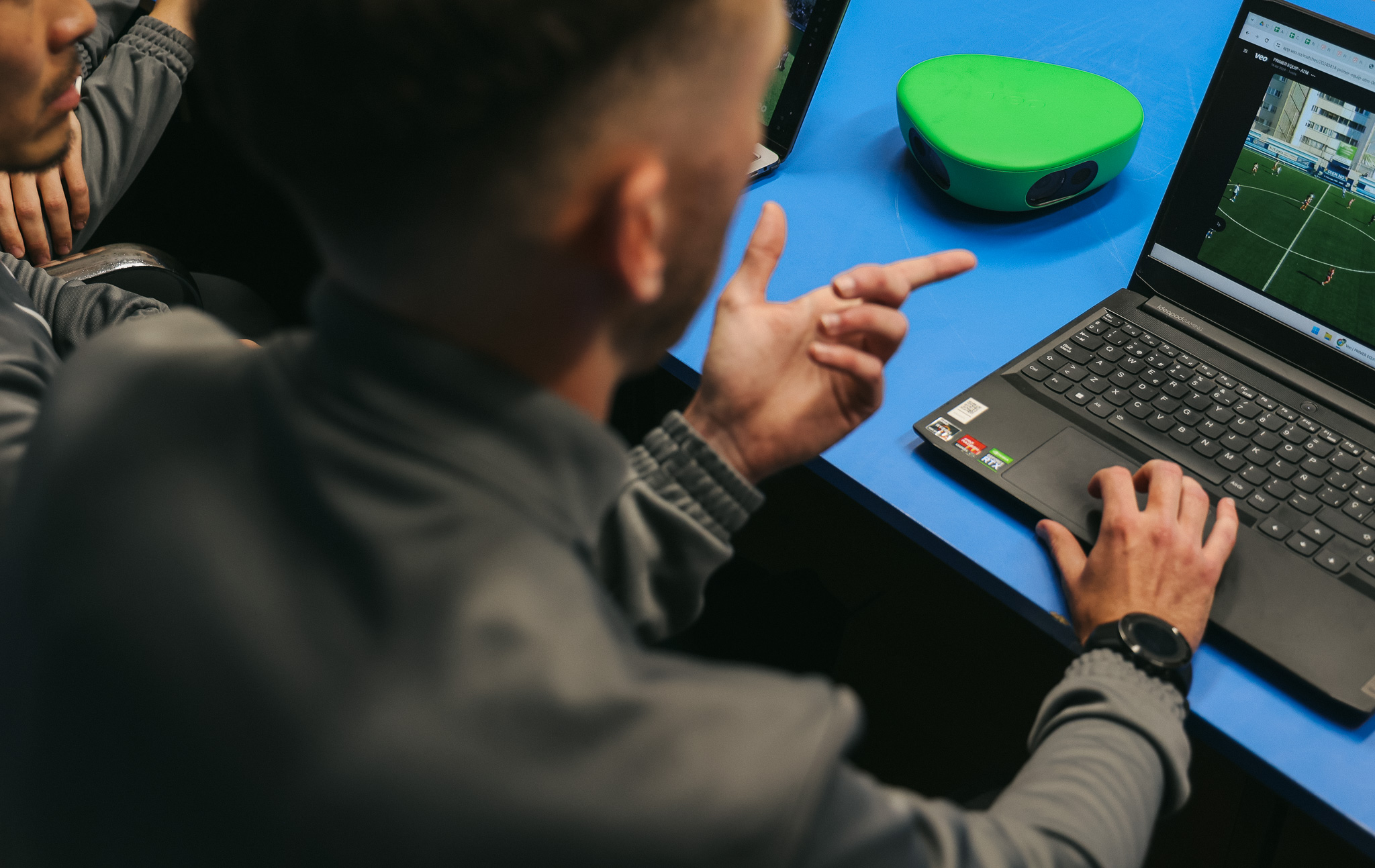
Veo's AI camera system removes that bottleneck. The camera films matches autonomously from an elevated position without any operator required. Footage uploads automatically to the Veo platform once the match ends. Automatic event tagging identifies goals, shots, set pieces, and key sequences across the full game without any manual input from the coaching staff.
Individual player tracking goes further. Select any player in the footage and Veo generates a reel of every moment that player was involved in, ordered chronologically, with full match context around each clip. A coach who needs to review a specific player's positioning or decision-making before a conversation the next day has everything they need within hours of the final whistle.
More than 40,000 clubs across 100 countries have made this their standard workflow, with over 4 million matches filmed on the platform.
See how Veo's Editor and automatic tagging support post-match analysis.
What is different about running video sessions with younger players?
With players at U12 and U14 level, the goal of a review session shifts. Tactical instruction matters less. Building the habit of watching yourself, and learning to connect what you felt to what actually happened, matters more.
Keep sessions visual and short. Show clips without extended explanations. Ask open questions. "What do you notice?" is a better opening than "Here's what went wrong." Let players talk to each other about what they see before you offer your reading of it.
Something reliable happens when younger players are given footage regularly and the space to engage with it. They begin asking for it. They debate clips with teammates. They start arriving at training with questions about specific moments from the previous match. That kind of self-directed engagement is difficult to manufacture through any other method.
The tactical complexity comes later. The habit, built early, is what makes that complexity learnable.
Frequently Asked Questions
How long should a post-match video review session be? For youth and grassroots teams, 15 to 20 minutes. For semi-professional environments, up to 45 minutes with a tight clip structure. Length matters less than focus. Five well-chosen clips with clear teaching points will outperform 20 clips shown at speed.
How soon after a game should you review footage? The same evening if possible, and before the next training session at the latest. The closer the review is to the performance, the more connected players are to the moments on screen. Feedback that arrives 48 hours after a game competes with a player's fading memory of it.
What should you look for when reviewing match footage? Focus on the areas that reflect your team's tactical priorities: defensive organisation, offensive patterns, and individual moments worth addressing. Select clips that show both what worked and what needs to improve. Never show only mistakes.
How many clips should a review session include? Three to five for a 20-minute session. One positive clip to open, two or three teaching clips, one individual or small-group clip. End with a single action point connected to the next session.
Can coaches without analyst support run effective video sessions? Yes. AI camera systems handle filming, upload, and basic tagging automatically. A single coach can run the same core review process within the time available between games, without a dedicated analyst or hours of manual clip preparation.

Curious to discover more about sports analysis?
Elevate your sports analysis with our software
.jpg)


.jpg)