Football Warmup Routines That Actually Prepare Young Players
Frederik Hvillum

Eight football warmup drills for youth coaches. Dynamic movement, ball activation, and position-specific preparation for players aged 8 to 14.
Most youth football sessions start the same way: players jog a lap, do a few static stretches, and then the coach tries to run drills on cold bodies that are not ready to move at speed. Muscles are not warm, joints are not activated, and the first fifteen minutes of skill work are wasted because players are still waking up.
A structured warmup does three things: it raises the heart rate, activates the specific muscles used in football, and gives players early touches of the ball so they arrive at the skill work phase already in a football mindset. This guide covers eight warmup drills that achieve all three, with age guidance and coaching cues for each.
Film your warmup with Veo Cam 3
Record the full session automatically. Review warmup intensity, movement quality and early engagement patterns the same evening.

Why fun games belong in every football practice
The most effective youth football sessions combine deliberate skill work with game formats that feel like play. Pure drill repetition builds technical habits but can reduce engagement over time, particularly in younger age groups. Games that have competitive stakes, clear objectives, and immediate feedback keep intensity high across the full session.
Three principles underpin every warmup drill in this guide:
- Ball contact from the first minute. Even in dynamic movement drills, a ball is preferable to no ball. Touches build confidence and set the tone.
- Progressive intensity. Start at 60 to 70 per cent effort. Build toward full pace in the final phase before skill work begins.
- No static stretching at the start. Cold muscles do not benefit from static stretching and may be more prone to strain from it. Save static stretching for the cooldown.
For a complete framework of how warmup fits into a 90-minute session structure, see the youth football practice guide.
Warmup drill overview
| Drill | Age group | Duration | Key focus |
|---|---|---|---|
| Colour gate passing | U8–U14 | 8 min | Passing, movement, decision-making |
| Dynamic movement pattern | U8–U14 | 6 min | Coordination, body control |
| Rondo 4v1 | U10–U14 | 8 min | Passing, positioning, pressure |
| Ball mastery sequence | U8–U12 | 8 min | Close control, first touch |
| 1v1 activation | U10–U14 | 8 min | Dribbling, defending, intensity |
| Positional passing triangle | U10–U14 | 8 min | Combination play, movement |
| Speed gate run | U10–U14 | 6 min | Explosive movement, agility |
| End zone activation game | U8–U14 | 10 min | Transition, decision-making |
The warmup drills
Drill 1: Colour gate passing
Set up six small gates (two cones, 2 metres apart) in random positions across a 20x20 area. Give each gate a colour using bibs or coloured cones. Players pass in pairs through as many gates as possible in 4 minutes, counting successful pass-throughs. Increase difficulty by calling a colour: pairs must find a gate of that colour before the next call arrives.
Coaching cue: "Keep your head up between passes. You are looking for the next gate before the ball arrives at your feet."
Age note: U8 and U10 groups can use two colours and larger gates (3 metres). U12 and above can use three colours and reduce gate width to 1 metre.
Drill 2: Dynamic movement pattern
Players jog freely in a 25x25 area. The coach calls a movement pattern: jog, sprint, backpedal, shuffle left, shuffle right, jump. Players complete each movement on the call and return to a jog between calls. After 3 minutes, add a ball: players dribble while responding to movement calls.
Coaching cue: "React the moment you hear the call. No looking at other players first."
Drill 3: Rondo 4v1
Four players in a 10x10 square, one player in the middle. The four outside players keep possession with one- and two-touch passing. The player in the middle tries to intercept or force a mistake. When the middle player wins the ball, the player who lost possession takes their place. Run for 6 minutes, rotating the middle player every 90 seconds if no interception is made.
Coaching cue: "Open body, show the pass before the ball arrives. Your first touch sets up your next pass."
Age note: For U8 and U10, use a 12x12 square and allow unlimited touches.
See what your warmup looks like from above
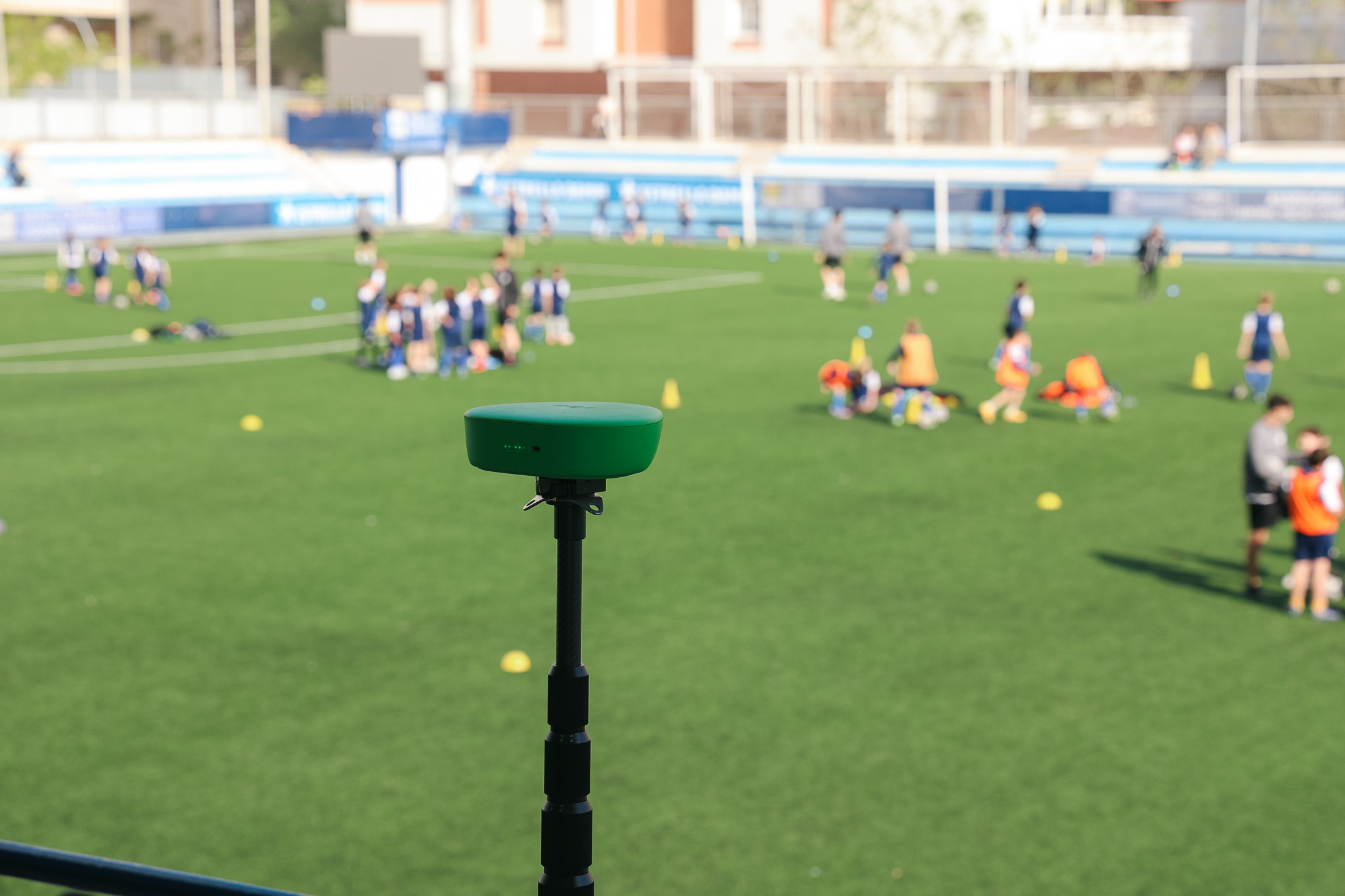
More than 40,000 clubs across 100 countries use Veo to store and share footage, with over 4 million matches filmed on the platform (Veo internal data, 2026). Veo Cam 3 records the full session automatically so coaches can review warmup intensity and player engagement after every session.
Drill 4: Ball mastery sequence
Each player has a ball in a 5x5 personal space. The coach calls a movement sequence every 20 seconds: toe taps, inside touches, outside cuts, pull-backs, step-overs. Players complete as many repetitions as possible before the next call. Keep energy high and transitions fast between movements.
Coaching cue: "Soft touches. The ball stays close to your foot."
Age note: Suitable from U8. For older groups, add directional movement: players must complete each sequence while slowly moving to a new area of the grid.
Drill 5: 1v1 activation
Pairs of players stand 4 metres apart with a ball between them. Player A rolls the ball, Player B collects and attacks the space behind Player A for a 1v1. Player A turns immediately to defend. Run for 30 seconds per pair, then swap roles. After 4 minutes, increase the starting distance to 8 metres.
Coaching cue for attackers: "First touch in the direction of your run, not back toward the defender."
Coaching cue for defenders: "Turn before you chase. Get your body between the attacker and the space."
Age note: Introduce at U10 once players can execute a controlled first touch under light pressure. At U8, use unopposed dribbling toward a target cone instead.
Drill 6: Positional passing triangle
Three players in a triangle, 8 metres per side. Player A passes to Player B, follows the pass, and takes Player B’s position. Player B receives, plays first time to Player C, and follows. The triangle rotates continuously. After 3 minutes, add a fourth player in the middle who tries to intercept.
Coaching cue: "Move as the ball moves. Arrive at the next cone as the pass arrives."
For more drills in this style, see the fun football games for kids guide.
Drill 7: Speed gate run
Set up eight gates (pairs of cones, 1 metre wide) randomly across a 20x20 area. Players sprint through as many gates as possible in 15 seconds. Count gates. Rest 15 seconds. Run 5 rounds. Add a ball and require dribbling through each gate for the final two rounds as a bridge into skill work.
Age note: Appropriate from U10. For younger groups, extend the time to 20 seconds and widen the gates.
Drill 8: End zone activation game
Split players into two teams of four to six. Two end zones marked with cones at opposite ends of a 30x20 pitch. Teams score by dribbling the ball into the opposing end zone under control. No goalkeeper, no tackles: defenders can only intercept passes or step in front of dribbles without making body contact. Play for 8 minutes with continuous restarts.
Coaching cue: "Find the space, not the player. The end zone is wide."
Using video to review warmup quality
Warmup quality is one of the hardest things to evaluate while coaching live. A coach running a rondo has to watch the middle player, the receiving players, the ball, and the positioning of players off the ball simultaneously. Something is always missed.
Coaches using Veo Cam 3 set it up before players arrive and record the full session from start to finish. Reviewing warmup footage reveals patterns that are invisible in the moment: the player who always switches off during ball mastery, the group whose rondo intensity drops after 90 seconds, the pair whose 1v1 activation is technically fine but lacking genuine competitive effort.
For agility-focused drills that work well as standalone warmup activities, see the youth football drills guide, which includes ladder sequences, cone patterns, and reaction drills that suit all age groups from U8 to U14.
Adapting warmup routines by age group
- U8–U10: Prioritise ball contact, fun, and movement variety. Avoid long explanations. Drills 1, 2, 4, and 8 work best. Attention span is 3 to 5 minutes per activity.
- U11–U12: Begin introducing light competitive pressure. Drills 3, 5, and 6 suit this group. Extend rondo grids and triangle distances as technical confidence builds.
- U13–U14: The full eight-drill sequence can run at higher intensity and with tighter constraints. Add pressing triggers, cut transition time, and run drill 7 at game pace.
Record your next session from start to finish
Veo Cam 3 sets up in under 2 minutes. No operator needed. Full footage ready to review and share with players the same evening.
Related reading
- How to plan a youth football practice
- Fun youth football drills for agility and coordination
- Fun football games for kids
%2520(1).jpeg)

FAQs
For players aged 8 to 10, 10 to 12 minutes is enough. For U11 to U14 groups, 12 to 15 minutes allows time for dynamic movement, ball activation, and a short competitive element. Warmups longer than 20 minutes eat into skill work time without producing additional benefit.
Static stretching is not effective as a warmup for cold muscles. It belongs in the cooldown phase when muscles are warm and pliable. Youth football warmups should use dynamic movement: jogging, shuffling, changes of direction, and ball work. Reserve static stretching for the final 5 minutes of a session.
There is no single best drill, but rondos and small-sided activation games consistently produce the highest quality warmup for youth players. Both give every player early ball contact, require active decision-making, and generate genuine competitive intensity without explanation from the coach.
Keep every drill competitive or gamified. Count passes, count gates, award points. Avoid warmups where players stand in a line waiting for a turn. All drills should keep every player active simultaneously. For U8 to U10 groups, warmup games like freeze tag or end zone activation produce higher effort levels than any formal warmup drill.
From the first session. Even U6 and U8 players benefit from a structured warmup that raises their heart rate and gives them early ball contact. The structure should be simple: two to three activities, no more than 4 minutes each, with a ball involved throughout. The habits that form in early youth training carry forward.
.jpeg)