Lacrosse Wall Ball Drills Every Youth Player Should Do Daily
Veo
Five lacrosse wall ball and stick skill drills for youth players. Dominant hand, off-hand, quick stick and box footwork with coaching cues and rep targets for U10 to U14.
The players who improve fastest between seasons are not the ones who attend the most team sessions. They are the ones who work alone with a stick and a wall. Wall ball is the single highest-return individual practice available in lacrosse: every throw comes straight back, every catch is immediate feedback, and 20 minutes produces more stick repetitions than most full team sessions.
This guide covers five wall ball and stick skill drills for youth lacrosse players aged 10 to 14. Each drill targets a specific stick skill: dominant hand mechanics, off-hand development, quick stick reaction, stick protection, and cradling under pressure.
Why wall ball is the most important individual lacrosse skill drill
Lacrosse is a stick sport. Every other skill in the game: dodging, shooting, clearing, defending, depends on the ability to throw and catch with both hands under pressure. Players who cannot catch consistently cannot execute any team pattern reliably. Players who can only catch with their dominant hand are predictable to every defender they face.
Wall ball solves both problems in the most time-efficient format available. The wall never misses a pass, never gets tired, and never complains about the weather. A player with a wall, a ball, and 20 minutes has everything they need to close the gap on more experienced players.
For players still developing basic cradling and catching mechanics before wall ball, see the youth lacrosse drills for beginners guide first.
What are the best wall ball drills for youth lacrosse players
These five drills build stick skill progressively, from fundamental throwing and catching mechanics through to pressure-tested cradling with footwork.
1. Basic Wall Ball (100 reps)
Stand 5 metres from the wall. Throw the ball at a target spot at shoulder height, catch the rebound, and repeat. Keep a consistent throwing motion: step with the opposite foot, pull the top hand through, follow through toward the target. Count to 100 consecutive catches. If the ball is dropped, start the count again from zero.
The restart-from-zero rule is the most important element of wall ball. Players who count drops build tolerance for inconsistency. Players who must reach 100 consecutive catches develop the focus and mechanics that make consistency automatic.
Coaching cue: "Aim at the same spot every throw. If the ball comes back to a different place each time, your release is inconsistent."
Age note: For U10, start at 3 metres and target 50 consecutive catches before extending distance or count.
2. Off-Hand Wall Ball (100 reps)
Identical to basic wall ball, but throwing and catching with the non-dominant hand only. No switching. 100 consecutive catches with full throwing mechanics on the off-hand.
Most youth lacrosse players have a dominant hand that functions well and an off-hand that functions badly. The gap compounds over time. Dedicated off-hand wall ball is the only way to close that gap. A player with a reliable off-hand doubles their threat level to any defender.
Coaching cue: "Your off-hand will feel wrong for weeks. That is normal. Keep the mechanics correct and the feel catches up."
Age note: Introduce at U10 alongside dominant hand work. At U12 and above, the off-hand session should be equal length to the dominant hand session.
3. Quick Stick (50 reps)
Stand 4 metres from the wall. Throw the ball, and as the rebound arrives, catch and release in one motion without cradling. The stick goes back to throwing position the moment the ball arrives and releases again immediately. Target 50 consecutive quick stick reps without a drop.
Quick stick is the drill that turns wall ball into a game skill. The best passing lanes in a real game are open for less than a second. Players who must cradle before passing always arrive a beat too late.
Coaching cue: "The ball should not stop. It arrives and leaves. Your stick is a redirect, not a catch."
Age note: Introduce at U12. Quick stick requires both hands to be reliable before the reaction-speed element becomes trainable.
4. Behind-the-Back Cradle (10 minutes)
Walk slowly cradling the ball. Every ten steps, switch the stick behind the back from one hand to the other without the ball leaving the pocket. Increase pace gradually. The focus is on stick protection and body rotation, not speed.
This drill builds the body awareness to protect the stick from a defender's check. Players who can move the ball from one side of their body to the other fluidly without looking have a significant advantage in 1v1 situations.
Coaching cue: "Keep the stick close to your body on the switch. A stick that goes wide is easy to dislodge."
The body rotation and stick protection mechanics built here feed directly into dodging. See the youth lacrosse midfield drills guide for how these skills combine in game-speed dodging situations.
5. Box Lacrosse Footwork Drill (10 minutes)
Set up four cones in a 5-metre square. Cradle the ball while moving through the cones: sprint to the first, side-shuffle to the second, backpedal to the third, side-shuffle to the fourth, and repeat. The ball must stay in the pocket throughout. Run for 10 minutes with 30-second rest every two minutes.
Box lacrosse demands lateral movement and backwards movement while protecting the ball, which are rarely trained in field lacrosse practice. This drill builds exactly the body control that separates players who handle the ball in space from players who handle it in traffic.
Coaching cue: "Eyes up, not on the ball. If you can see where you are going, you can see the defender coming."
How to structure a home wall ball session
A complete individual session takes 20 to 25 minutes. Start with basic wall ball to warm the throwing arm. Move to off-hand before fatigue sets in. Quick stick comes third when both hands are warm. Behind-the-back cradle allows recovery between throwing-heavy drills. Close with the footwork circuit, which doubles as conditioning.
Frequency matters more than session length. Two 20-minute sessions per week produces more improvement than one 60-minute session. Three sessions per week produces measurably better development than two. The wall is always available.
For the shooting mechanics that wall ball directly supports, see the youth lacrosse shooting drills guide. Players who do regular wall ball arrive at shooting sessions with the release mechanics already in place.
More than 40,000 clubs across 100 countries use Veo to store and share footage, with over 4 million matches filmed on the platform (Veo internal data, 2026)
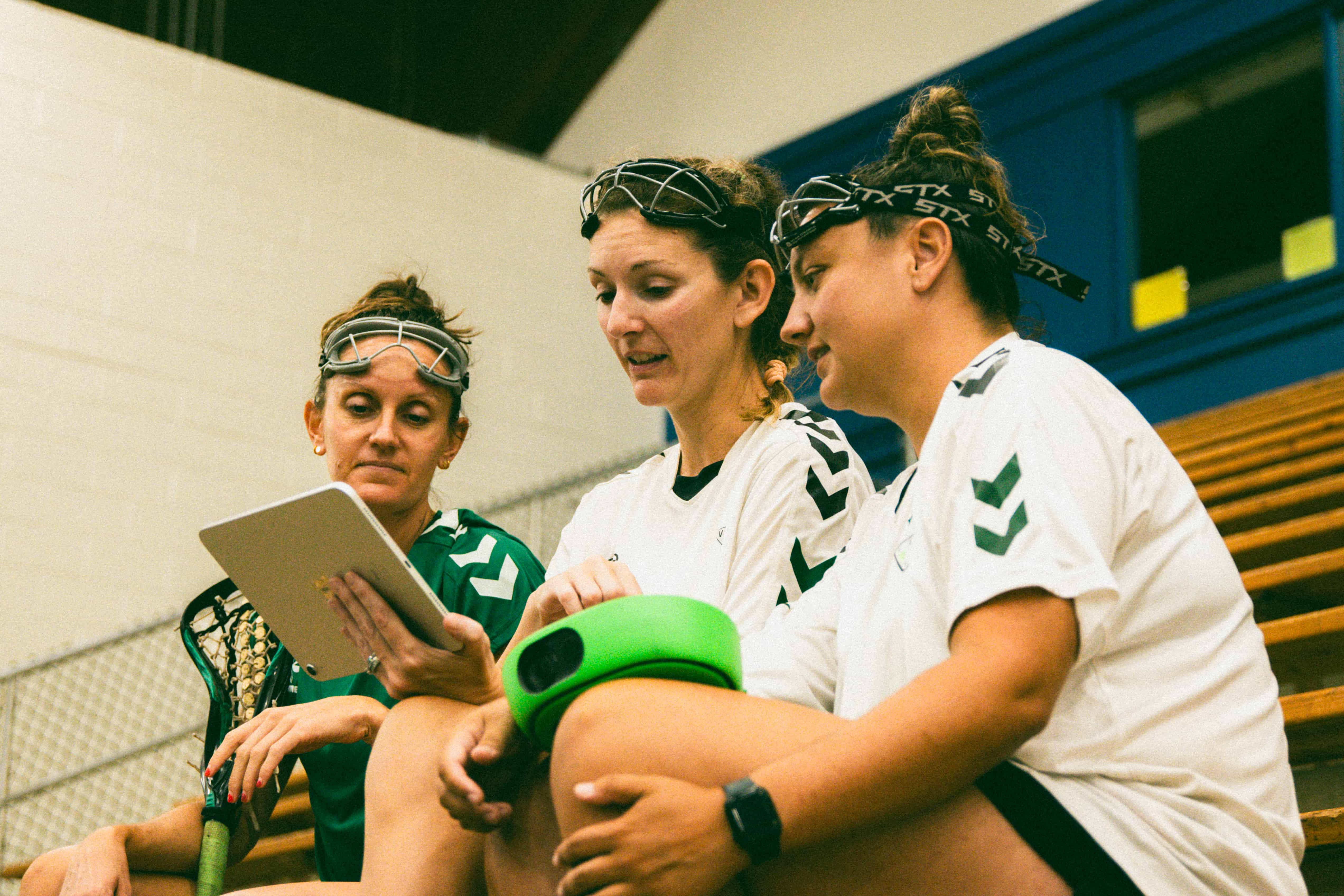
Veo Cam 3 records individual practice automatically so coaches and players can review stick mechanics in detail after every session.

FAQs
The basic wall ball drill on the dominant hand is the most important starting point. Once 100 consecutive catches are reliable, add the off-hand drill. Quick stick follows when both hands are consistent. Players who do 15 minutes of wall ball three times per week improve faster than players who attend extra team sessions without individual stick work.
Start at 3 metres for U10 and younger. Move to 5 metres from U12 as arm strength and accuracy develop. The correct distance is the one where the player can throw and catch in a consistent rhythm without dropping more than one ball in ten throws. Too far means the player is compensating for power rather than developing mechanics.
100 reps on each hand is a reasonable target for a 15-minute session from U12. At U10, start with 50 reps on the dominant hand and 25 on the off-hand. The goal is consistent mechanics over the full set, not pure volume. Stopping when mechanics break down and resetting is better than completing reps with poor form.
Wall ball develops individual stick skills that team practice cannot replicate in the same volume. A player gets more catching repetitions in 20 minutes of wall ball than in a full team session. But wall ball does not develop game reading, communication, or team patterns. Both are necessary: wall ball builds the tools, team practice teaches when and how to use them.
A lacrosse stick, a lacrosse ball, and a flat, solid wall. A rebounder or rebounding net works well if no wall is available. Gloves are recommended from the start to build the catching habit with equipment players will use in games. A second ball is useful so practice does not stop every time a ball is missed.
%20(1).jpg)
.jpg)