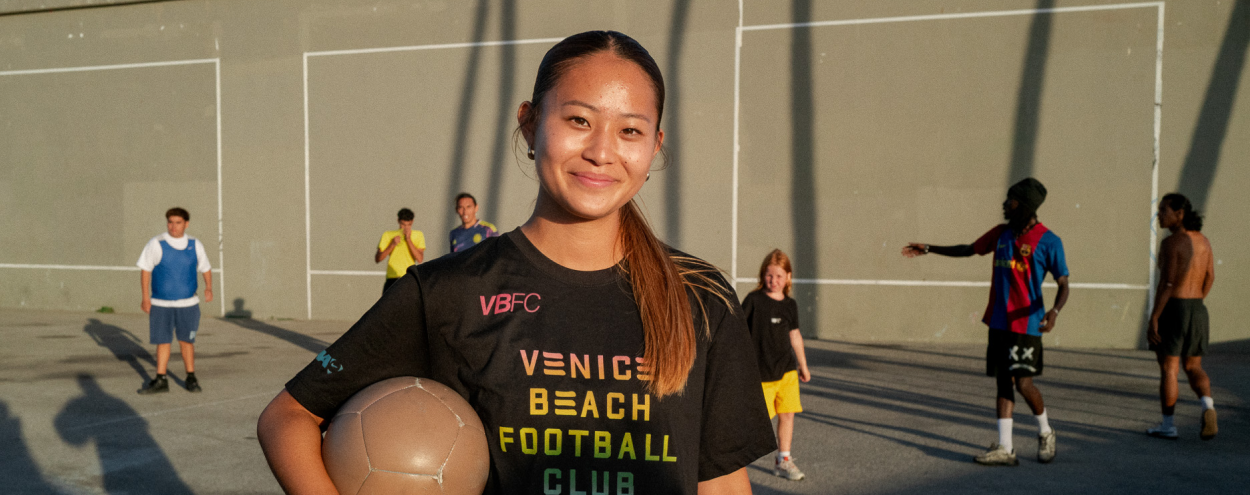
Mina Nagashima's favorite thing to do with a football is put it through an opponent's legs and collect it on the other side.
"It's a really good feeling to meg someone," she says.
There is a clip of her doing it. The ball goes through, she is past the defender before the defender has turned, and you can hear what the defender says about it.
It was seven in the morning in Redondo Beach when she sat down to talk about it, with a school day still ahead of her. In January, she leaves California for the University of Minnesota, a semester ahead of her graduating class and on a scholarship, to play Division I soccer and study chemical engineering.
She describes her own game in two sentences.
"Currently I'm playing left winger at Beach FC," she says. "I'm inverted. I'm right-footed, so I like to cut in."
Her favorite player is Kaoru Mitoma, a right-footed left winger for Premier League club Brighton & Hove Albion. He plays her position on her foot, and taking defenders on is the center of his game too.
Where the other side comes out
Nagashima came up on hard courts as much as on grass. She joined Toque, a futsal setup, as a small child, and she now plays TOMA events on the tarmac at Venice Beach.
"When I was little, I used to do Toque, which was like a futsal organization. I really enjoyed that, so when I heard TOMA was introduced, I wanted to join so badly," she says, "because I knew that's where my happiness, and a different side of me, comes out. My competitive side. I really like taking people on 1v1, showing off my skills."
"The field is so small you have to use your skills to get around people," she says. "That's where you do all these fancy tricks, you start megging people, and that side just comes out."
Ask her what a new-school LA baller looks like and the answer is one word.
"I feel like it's all about the megs," she says. "LA ballers always do these flicks too, but for me personally it's all the megging that everyone does."
She came back from a TOMA event in New York having played teams from outside the country, and the contrast gave her something to measure against. A Canadian side played quick, passed and passed again and then shot, while her own group went looking for megs and flicks.
"It's fun to play against those different styles because you have to adjust, but you also want to showcase your own abilities compared to other teams," she says. "That's the good thing about LA; we stood out in a completely different way."

Whoever is across from her
At Toque, she spent her early years playing with boys, which she treats as a technical education.
"They were all techy, and the pace of the game was much faster, which really helped me grow as a player and helped my touches and skills, because I had to adapt to a different style," she says.
What she took from it covers every opponent she meets.
"I'm always looking for competition, so I don't really care who I play against. They could be the best soccer players in the world, or someone like me. Gender doesn't matter to me. I'm always open to whoever I'm playing against."
The team that cut her
Nagashima has avoided the injuries that end seasons, with a run of ankle sprains as the worst of it. A setback that knocked her came off a team sheet instead, when she was small.
"I did get cut from a team when I was little, and that struck my confidence and motivation for soccer," she says.
She gave it a few days and then went back out with a ball.
"After a few days I went back on the field and started touching the ball again, and it took my mind off it. I was like, okay, I'm here right now, I have to work harder."
Friends, family, and the private coaches she was working with kept telling her to carry on, and she knows what quitting would have cost.
"If I'd quit soccer back then, my whole life would have been so different, and I'm really glad I kept going, because I wouldn't be here otherwise."
The cut took her confidence, and she links it directly to enjoying the game.
"Happiness is important in soccer in general. If you're not happy, you're not going to enjoy the game, you're not going to have confidence, you won't want to be there."
At FRAM SC in Torrance, her club prior to Beach FC, she got that confidence back, and she credits the club with the player she became. The coach there kept telling her to take players on, and treated a mistake as fine as long as she won the ball back afterwards.
"This is where my confidence really started to show throughout games."
Two hours each way
Before Beach FC, she spent a stretch at Tudela FC in Los Angeles. It built its program around technique, and getting there cost her most of three evenings a week. School finished at half past three in Redondo and practice was in LA, which meant about two hours in traffic on the way up and thirty to forty-five minutes coming home, putting her through the door around ten at night with dinner and homework still ahead of her.
"Traffic is horrible, but that club helped me a lot with skills," she says.
She slept through the outbound leg, and her parents mentioned it every time.
"Every single time I'm in the car, my parents are like, 'you're always sleeping,' and I'm like, sorry, but I'm tired; I just came back from school."
She made that drive three times a week to get to a ball.
"Every single time I have the ball at my feet, it makes me happy, and I forget about everything else going on," she says. "I'm just in my own world."
Minnesota, and three engineers at home
When Minnesota got in touch, the first thing Nagashima did was research the academics.
"When I saw that Minnesota was interested in me, I looked at all their school information and learned they had a really good engineering program, which is what I want to major in," she says.
There is a reason that was the first thing she checked. Her older sister graduated from UCSD as a biomedical engineer, her other sister is a chemical engineer, and her father is a mechanical engineer. Nagashima is going for chemical engineering, which makes three in the family and a fourth on the way.
"I look up to all of them and want to be an engineer too," she says.
Minnesota solved the problem she had set herself, which was to find one school that could carry both halves of her week. The Gophers play in the Big Ten Conference against programs like UCLA and USC, and the engineering school is, in her words, "top, top."

Her parents have pushed school, homework, and SAT prep for as long as she can remember, and they also push her out the door with a ball.
"My parents are always on about school, homework, studying for the SAT, but at the same time they're also like, okay, go touch a ball now," she says. "So it felt natural to look for a school with a good balance, especially because if soccer doesn't go the right path, at least I'll have education, or if education doesn't go the right path, maybe I have soccer."
Advice for the ten-year-old
Asked what she would say to a younger player who follows her, Nagashima started with fun.
"I'd say to have fun and enjoy the game; that's the biggest part of playing soccer, because if you're not having fun you won't have the motivation to play," she says. "I'd also tell them that whatever challenge gets in your way, try your best to overcome it, and never give up."
Then she named the thing she had to survive, which was other people's opinions of how she plays.
"Growing up, a lot of people judged me or yelled at me for trying to dribble, for trying to take someone on 1v1. Just do what you want to do, and you'll get to where you want to be."