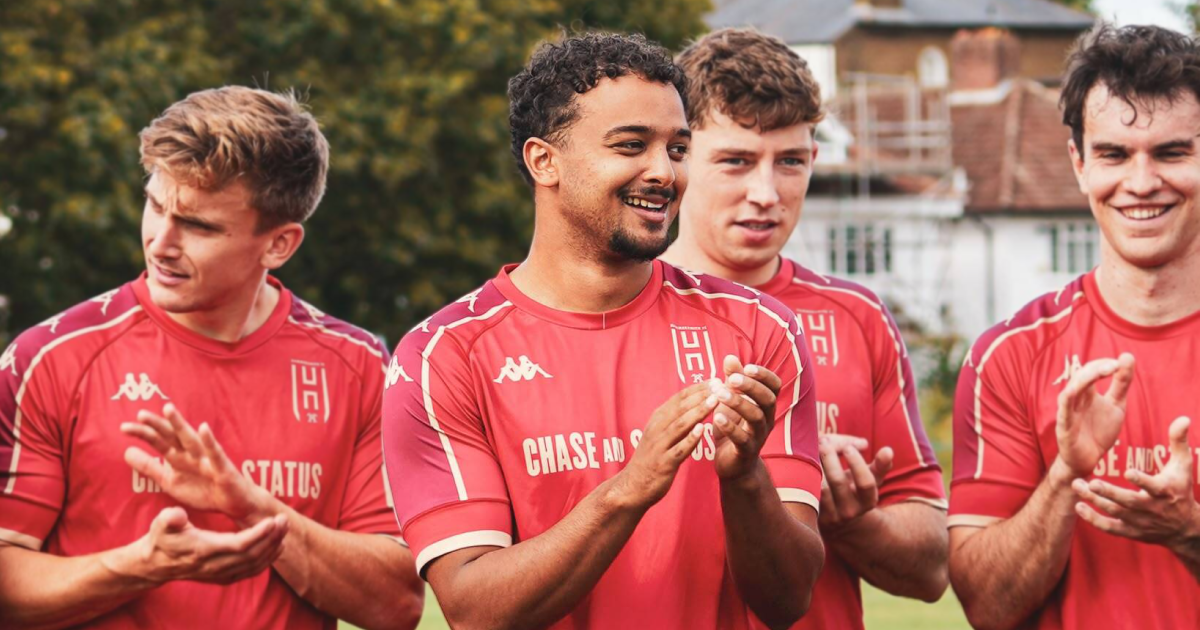
Sami Omar started playing for Hammersmith FC at 16. It was casual then, something he did because he knew the guys and the club was local.
He had bigger things on his mind. He was at Hampton School in West London, doing well academically and already good enough at football that people outside his immediate circle were taking notice.
Hampton is a serious school and doesn't do day releases for academy training, so players who wanted to take the professional route faced a choice. They could move to a school that accommodated it, get homeschooled, or find another way.
Omar didn't want to give up his education, so he started looking at American universities, where a scholarship could let him play at a high level without sacrificing his studies.
It was going well, and programmes he liked showed interest. Then COVID hit.
The year that disappeared
The timing was almost as bad as it could be. International scholarship places dried up overnight. Omar took a gap year and tried again, but the second wave came, and the coaches who had been watching his tapes all gave him the same answer.
"We like you, but we cannot put that kind of money towards someone we have never seen play in person."
There was also his hip. It had been getting worse for months, and the injury was easy to misread. He could play 45 minutes without much trouble, but the day after a match he could barely walk.
"I went through three physios on the trot," he says. "Each one told me something different. It wasn't until the third one said just get an MRI, to at least eliminate some possibilities, that I actually found out what was going on."
The scan showed a structural problem in the hip socket that rehab could not fix. He could have injections to manage the pain and keep playing, or he could have surgery.
He chose surgery and started at the University of Manchester the same year, which meant a full year without football.
Looking back, he thinks it was lucky that neither the US scholarship nor the Brighton trial went ahead. Either one would have exposed the hip problem straight away.
"I probably would have gone out there," he says, "and they would have immediately realised I had a problem."
Three years off
The year after surgery, Omar tried to return. Football was available at university, but his rehab wasn't structured the way it needed to be, and he got caught up in student life. When he finally tried to play properly, he pulled his hamstring and then his calf.
He stopped playing. He went to the gym with his flatmate and hated every minute, and three years passed without football.
Instead, he watched every game he could find, from the Premier League and the Champions League to anything else on television. He was putting on weight and not exercising, and he says he was not in a great place. He cannot say for certain how much of that was tied to not playing, but watching football became the way he switched off.
About a year and a half into the break, he realised how much he missed playing. When he finished university and moved back to London, Hammersmith was still there, and what made him go back.
The Swiss Army knife
The question of what position Omar plays has always been a running conversation.
He started as a winger, and an early growth spurt made him one of the taller kids in his age group. At 12 or 13, his Independent Schools Football Association (ISFA) squad lost all four centre backs to injury in the same tournament, so they moved the tall, fast winger to centre back. He played the rest of the trials there, got selected for the national representative team, and went back to school listed as a centre back.
Everyone eventually caught up with him physically, but he kept a winger's attacking instincts. He settled at left back, where he could defend and get forward, and it worked.
At Hammersmith, he plays wherever the team needs him. Last game he was at right wing, the game before that at left back, and he will slide into centre back if they ask.
"I don't care where I play," he says. "As long as I feel like I've had a good game there."
What he cares about is understanding the role, knowing his options before the ball arrives and never getting caught in a position he hasn't thought through.
That habit carries into his working life too. He works in a client-facing role, hates being asked a question he cannot answer, and gets ahead of the difficult conversations. He is not sure whether football gave him that quality or just made it more visible.
"The worst feeling for me is not being confident in the decisions I'm making. I want to already know my passing options before I receive the ball."
Seeing it back
Hammersmith films its matches with Veo, and Omar watches the footage the way he used to watch tapes for college recruitment, without the pressure attached.
"When you're playing, you think you know what happened," he says. "You watch it back, and it's completely different. Things you didn't see at the time become obvious. Things you were sure about, you realise you were wrong."
For a player who thinks as much about positioning as Omar does, the footage lets him check whether the decisions he made in his head matched what happened on the pitch. Usually, there is a gap.
The team watches film together too, which takes some of the heat out of individual mistakes when the whole group can see the same picture and work through it.
Playing for the right reasons
Away from Hammersmith, Omar runs a five-a-side team with a group of mates on Wednesdays. Getting everyone to turn up is a whole operation, and he is always the one chasing people and sending messages. Then they play, and they all come away glad they did.
Some of his friends who are very good footballers want to go semi-professional and fit it around their nine-to-fives. He understands the impulse, but it is not what he wants. The level at Hammersmith is high enough for him, and some of the players there are exceptional.
"I'm so happy just pushing myself to get fit and play at a good level," he says. "And then we all go to the pub after."
For younger players at the same crossroads, watching pathways close and wondering whether they chose correctly, his advice is to work out what football does for you before it gets taken away.
"I didn't really clock how much I loved the game until a year and a half into not playing it," he says. "Knowing why you play. That is the main thing."