How The Girls Academy Builds Talent Without Breaking Kids
Magnus Holt

Patricia Hughes is in her third year as commissioner of the Girls Academy and has watched players go from youth development to professional contracts to national teams. She wants her best players to get better, to get noticed, to compete against real opposition. She also wants to make sure none of that turns into more weight than a 13-year-old should have to carry. Those two things do not always pull in the same direction.
Patricia Hughes has some sense of what that weight feels like. She came up through the game in Ireland, from a working-class family, at a time when there was no real path forward for a young female player who wanted one. That is part of why the protective side of her job is not an afterthought for her. It is the reason the Girls Academy exists in the form it does, built specifically for what young women need to develop, not as a copy of how the boys' side does it.
That commitment shows up in the Girls Academy's actual structure, not just in how Hughes talks about it. It's a single-gender organization with female leadership, overseen by a board Hughes says exists specifically to back the players coming through the program, rather than a generic youth setup that treats every age group the same way.
This week, that's Emily
At the Generation Adidas Cup, that contradiction had a name. Emily Bernachea is 13. She plays for Florida United, and at the tournament she was moved up to compete in the U16 bracket, three years above her own age group. Her own teammates on the Girls Academy All-Star squad are mostly 15 and 16. So are the players lined up against her.
Florida United and its development program are how she ended up in that bracket at all. Hughes says the academy's system flagged Emily as ready for tougher competition well before her age group would have caught up to her on its own, and the decision to move her up came out of that process, not a hunch.
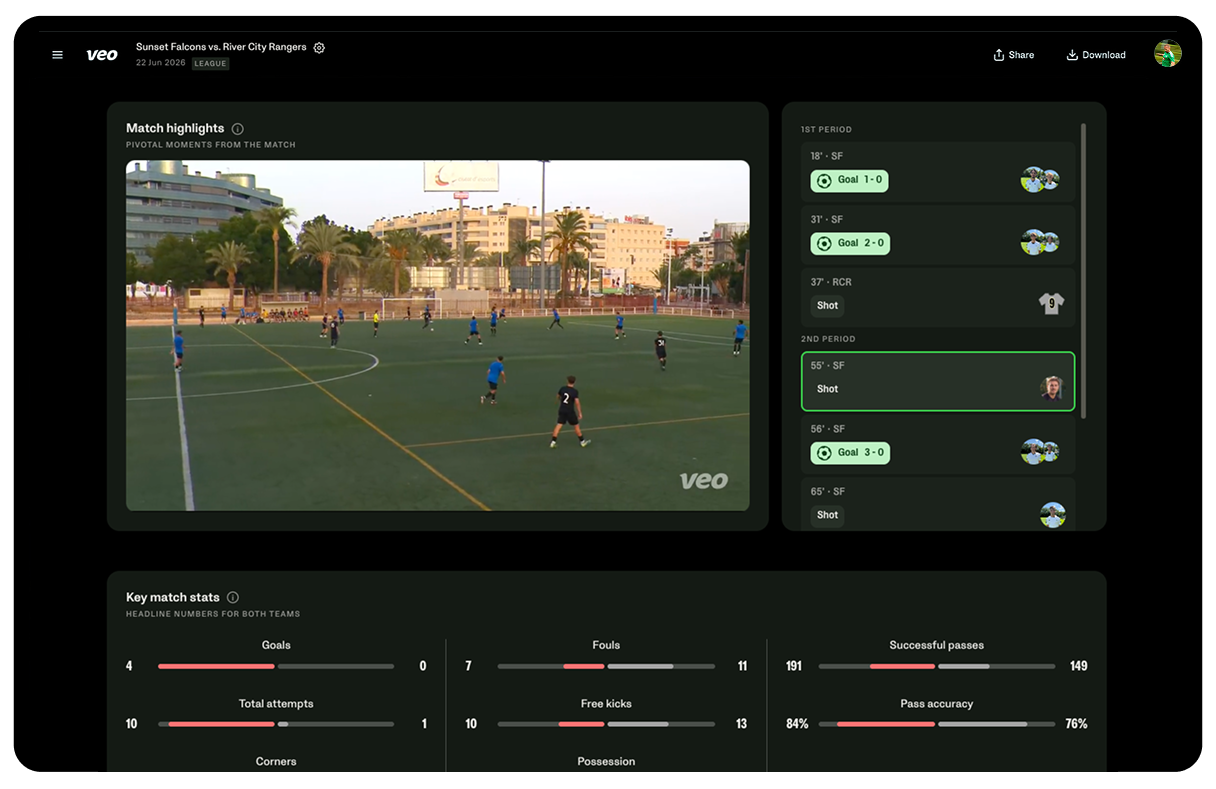
Read how ODP-style academies are using video analytics.
The stage she's playing on
The tournament itself is not a small stage to put a young teenager on. It's held at IMG Academy in Bradenton, Florida, on facilities Hughes calls first class, the kind of setup she says would not look out of place hosting the World Cup. "If this was the World Cup with 80,000 people," she says, "we wouldn't be too surprised."
The competition on those fields matches the setting. The event grew this year from four teams to eight. The new field includes Real Madrid, Bayern Munich, Club America, the NWSL's We League All-Stars, and four Girls Academy squads built from the top 80 players in the country. Some of the best American players in the girls' game were on the same fields this week as a group of 13 to 16 year olds.

For Hughes, the value of that level of opposition is what it forces her players to deal with on the field, not the spectacle of it. "It's all about meaningful games," she says. "How do we provide an environment that challenges these players." Four different countries bring four different ways of playing, different speeds, different physicality, and Hughes wants her best players tested against all of it rather than only against the teams they already know how to beat.
A process based on experience and clear intentions
So how do you put a 13-year-old in that environment, let her get tested and get noticed, without the whole thing turning into pressure she never asked for? Hughes says this is not new ground for the Girls Academy. They have done it enough times to have a standard way of handling it, not an improvised one. "When we get the opportunity to bring in a young player who is ahead of her development, we get to give her a chance to compete with players of the same level, or maybe a little older or more mature," she says.
See how women's football clubs are using video analysis.
Emily is three years younger than most of the field she played against this week, and by Hughes's account, she did more than hold her own in it. "She has come in and shone this week," Hughes says. "She has scored some great goals and demonstrated why she's a player to watch for the future." For Hughes, that's exactly the read she expected going in. "The fact that she's younger and she's rising to the occasion tells us we're spot on with what we believe is her pathway going forward," she says.
Where the real care goes
Hughes spends less time worrying about Emily's talent and more about everything built around it. "What's most important for us is that we insulate her and help her grow and mature," she says. "Children mature at different rates. It's critically important that we provide nurturing and guidance, given that she's younger but competing at a much higher level."

That guidance is not just a feeling, according to Hughes. It covers specific things the Girls Academy tries to teach every player who moves up early, not only Emily. "We want to grow them intellectually and emotionally," she says. "We want to teach them about emotional regulation and overcoming adversity, and being comfortable with being uncomfortable." Ask her what she actually worries about, and the answer has nothing to do with Emily's ability. "I love that she's a child," Hughes says. "There are too many situations where it's a group of adults making the decisions. What's really important for us to get out there is that these are children."
Still just a 13-year-old
None of this is built around the assumption that Emily, or any other player like her, is guaranteed to turn professional. Hughes is direct about that part. "The percentage of players who will find a way is very small, in a country the size of a continent," she says. That is exactly why the Girls Academy tries to build players who get something out of the experience either way, rather than treating every talented 13-year-old as a bet on a future outcome.
Read about the Girls Academy and Veo partnership.
By the end of the week, Emily had played several games against players three years older and held her own. That doesn’t make her a symbol of anything bigger. It makes her a 13-year-old who had a good week, which is exactly what Hughes says the Girls Academy is trying to protect in the first place.



.jpeg)