The Long Way Round: Sacha Serog on Gap Years, Broken Fibulas, and Playing for the Love of It
Frederik Hvillum
.png)
When covid wiped out his recruiting class, Sacha Serog did what most players wouldn't dare. He packed a bag and went looking for football in Paris, Madrid, and Germany. Two years and one broken fibula later, he came home with something more valuable than a contract.
Sacha Serog's father played football in the streets of Paris. His mother grew up swimming and playing tennis in Tokyo. They both ended up in New York, and they raised two boys who couldn't stop moving.
"My brother and I were very close in age," Serog says. "We just grew up playing soccer with my dad, playing tennis, just being active." Football was the one that stuck. By nine years old he was in his first club. By high school, playing for Downtown United Soccer Club (DUSC) in New York, he was thinking seriously about what came next.
Then covid happened.
The Year That Got Skipped
The timing was brutal. DUSC were one of the better teams in the country, going to the top tournaments, drawing college coaches. The class of 2020 was supposed to be their moment.
"They gave an extra year of eligibility to the current players," Serog explains. "They almost sort of skipped our recruiting class."
Faced with a closed door, he went sideways. He had a French passport. He had family in Paris. So he joined Mon Rouge FC, one of the city's better development clubs, whose youth setup would later produce players signed to professional teams across Europe. Serog was a year too old for their U19s, so he trained with the U20s in what was then a new, somewhat disorganized league structure. Decent training, a good name on the CV, a taste of Paris. Six months in, he moved again.
A friend and former DUSC teammate, Mattia, was trialing at RSD Alcalá, an affiliate club of Atletico Madrid, just outside the capital. He told Serog to come out. So Serog went to Madrid.
"That was probably one of the best teams that I was able to join and train with, just the tactical and technical ability of these players. They were all so small. The third-string goalkeeper was maybe five-five and would reach everything. One of the best keepers I've ever played with."
Five Feet Eleven and Learning
Serog describes himself as a technical player. Good in tight spaces. One and two-touch passing. Sharp movement. "I would say I am a particularly technical player. I was very good at one, two-touch passing, my movement, and good ball control."
In Spain, that was a good fit. The game there rewards exactly those qualities. But football has a way of testing what you think you know about yourself.
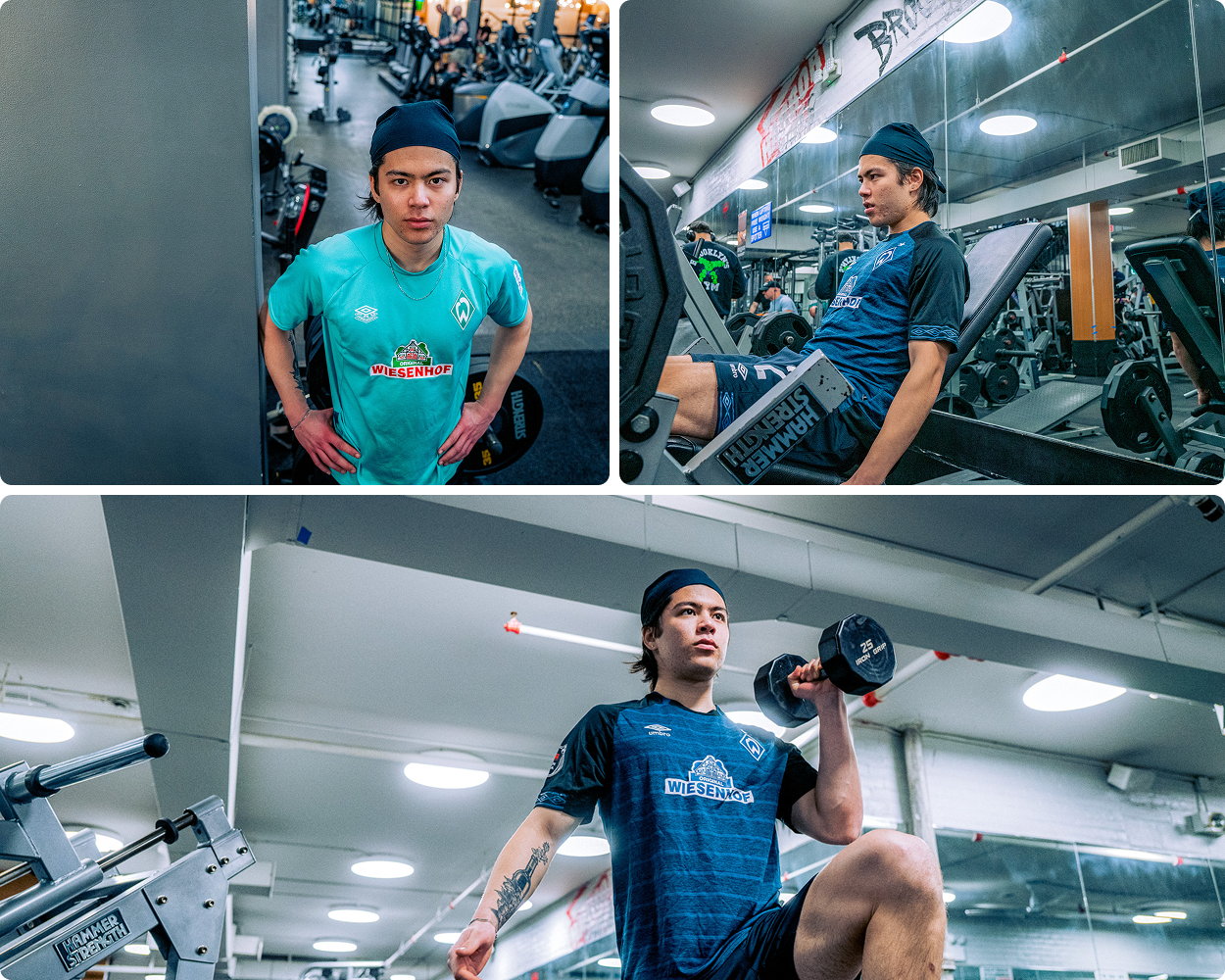
After returning from Madrid, Serog enrolled at Occidental College in California, walking into a starting role almost immediately with a year of European football behind him. Then Mattia's agent came through again. Werder Bremen's U21s needed a player in his position. Did he want to trial?
He did. He left Occidental after one semester, flew to Germany in January 2023, and within weeks was in the starting lineup.
"The coach really liked me, so I was put into the starting lineup pretty immediately," he says, still sounding a little surprised. "I was expecting to fight my way in."
The German game was different. Longer balls. More physical. Hold-up play rather than the quick combination work he'd developed in Spain. He adapted. He showed his speed and technical ability within the system rather than despite it. It was working.
Then, the Friday before a league game, a teammate came in hard and late in training.
"I broke my fibula."
The Plate, the Screws, and the Waiting
The injury required surgery. A metal plate. Screws in the leg. He was projecting a return by September 2023. It took until the summer of 2024.
"With football, there's a lot of contact, shooting the ball, getting the ball passed to me really hard. Having a controlled impact would really send a shock through my leg, which was pretty painful. I had to wait at least a year to remove the metal, and then make another two to three month recovery from the removal."
He came home. Re-enrolled at Baruch College in New York, known for its finance program. Took summer courses, winter courses. And trained, quietly and alone, while his leg healed.
"I knew I wanted to play again, and I didn't know when the tryouts were. I had no idea, but I was always ready for that moment. When they posted the open tryouts for the USL League Two club on their Instagram, I thought, I've been training for this for the past two months. I'm glad I was doing it on my own. The tryouts are in two weeks. If I had not been prepared, I cannot prepare in two weeks."
He made the team. Played the summer season in Staten Island. Four times a week, an hour's journey each way from Manhattan, for a semi-professional league, long after the professional dream had formally closed.
His teammate and friend Marvin watched this from a distance. "To see that he went through this whole journey and still had more to give, spending his summer training, waking up early, out in Staten Island. It's not an easy thing to do."
Serog doesn't frame it as sacrifice. "One of my goals was to really play again at a high level, at a very competitive level. If I could go back and play USL League Two, I'd be very happy with myself. And I was. That created the full-circle moment."
What the Camera Missed
Throughout all of it, the highlight reel was both tool and problem.
At DUSC, the club used a different AI tracking system. The technology was, in his words, unreliable.
"I'd be scrolling through the video and be like, what happened to this play? And it just missed it. Especially as an outside back, the camera's only on one side. If I was on the opposite side of the field, it was just not there. I would really just focus on performing when I was on the proper side of the field."
He still sent clips to college coaches. You work with what you have. But the footage from Paris was similarly blurry, similarly incomplete. "Again, we were still able to make a highlight video, which I ended up sending to Occidental and things like that. But it missed a lot of clips. Very blurry at times."
His first genuinely good footage came from the USL League Two season. Sharp tracking. Proper zoom. The kind of video you send without hesitation. "The first real professional highlight video I was really able to create was the one from USL. Because of the quality of the camera and the clips."
He'd been seeing Veo footage circulating by then and recognized it immediately.
"It's sharp, they zoom in well, the tracking is good. It's definitely something I wish I had back in my high school days. I see a lot of Veo clips these days."
What makes a good highlight reel, in his view, comes from the same logic he applied to his entire football career. Know what your strengths are, and show them honestly.
Serog: "For me as a defender and outside back, a good highlight video has some offensive clips, some defensive clips, clips where I'm keeping possession. Obviously goals, assists. And it shows your strengths while also showing the overall part of your role and position."
The Same Ingredients
Serog graduated from Baruch in December 2024 with a BBA in economics, completing a four-year degree in two years, and also earning a Summa Cum Laude honors. He starts at Equitable Advisors, a wealth management firm, once he finishes his licensing exams. Series 66 tomorrow. Series 7 after that.
He still plays in a Bowery league in New York with Marvin and others from the old DUSC days. PSG is his team. They won everything last season, finally.
When he talks about the football journey, there's no bitterness in it. Paris, Madrid, California, Germany, Staten Island. That arc sounds expensive and chaotic from the outside. From the inside, each decision made sense at the time.
"You're always having to prove yourself, no matter where you go, no matter the level. Even if you jump to a higher level and back down to a lower level, the people at the lower level don't care where you're from. They want to see that you can play. Until you prove that, that's what matters."
He thinks the habits are transferable. The alarm clock set for an early training session when no one is watching. The discipline of solo gym work on days when there's no team session. The willingness to be evaluated without complaint.
"I still to this day am hungry for new goals and new beginnings."
The football showed him how to do that. The footage, when it was good enough to capture him properly, showed him to the world.
He just wishes he'd had both a little sooner.
The Young Player Portfolio is our series dedicated to the players nobody told you about, yet. Real athletes, real journeys, documented from the ground up. Different journeys, same mentality.
Penelope Vineyard didn't plan to be a goalkeeper either. Read how one half of a recreational game changed everything.
Lexi Goodman NASA Tophat goalkeeper tore her ACL during what was supposed to be an easy game. Six months in, she's still the most positive person in the room.
Khalab Blagburn plays Division III at Pomona College and has no professional ambitions. Here's why he trains harder than ever going into his final season anyway.

%20(1).jpg)